
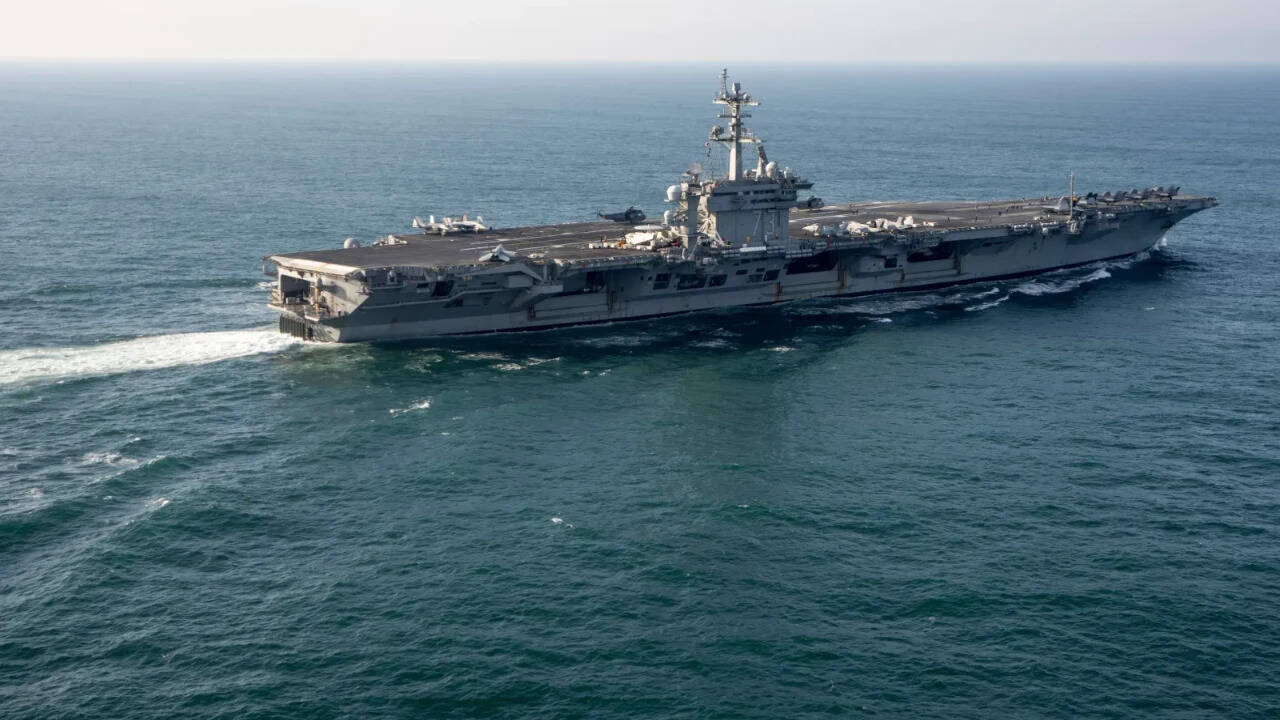
US is pulling its last aircraft carrier from the western Pacific to support the Iran war, temporarily leaving the region without a carrier as China steps up military activity. The United States is pulling its last aircraft carrier from the western Pacific as President Donald Trump’s war with Iran stretches the Navy’s ability to keep its biggest warships deployed, temporarily leaving a region where China is expanding its military presence without one of America’s most visible symbols of power.
The USS George Washington is leaving the Pacific to head for the Middle East, where it is expected to replace the USS Abraham Lincoln, which has spent more than eight months at sea supporting US operations against Iran. The move will temporarily leave the western Pacific without an American aircraft carrier, a potentially short-lived gap if the Navy sends another carrier to the region in the coming months, but one that analysts say carries symbolic weight for US allies and for China.
The Washington’s redeployment comes as concerns mount over the strain of prolonged deployments on the Lincoln’s roughly 5,000 sailors and Marines. The carrier has now spent more than 260 days deployed, with its return repeatedly pushed back as the Trump administration continues its military campaign against Iran.
It was separately reported that the Lincoln is expected to return after a 266-day deployment, amid growing scrutiny over the welfare of its crew. A carrier gap in the PacificThe absence matters because an aircraft carrier's presence is also intended to reassure US allies and demonstrate Washington's ability to project military power across the region.
China regards the US military presence in the western Pacific as a challenge to its ambitions, including its claim over Taiwan. The United States, meanwhile, has repeatedly described the Indo-Pacific as a central strategic priority.
“The administration says that the Pacific is supposed to be the most important behind the Western Hemisphere,” said Greg Poling, director of the Southeast Asia Program at the Center for Strategic and International Studies in an interview with news agency AP. Instead, he said, Washington is doing the opposite of its previously stated goal of reducing its Middle East commitment.
Clark said Beijing could use the gap to reinforce the message to countries including Japan, the Philippines and Indonesia that China is becoming the dominant military power in the western Pacific. No one expects China to launch an invasion of Taiwan simply because one American carrier has left the region.