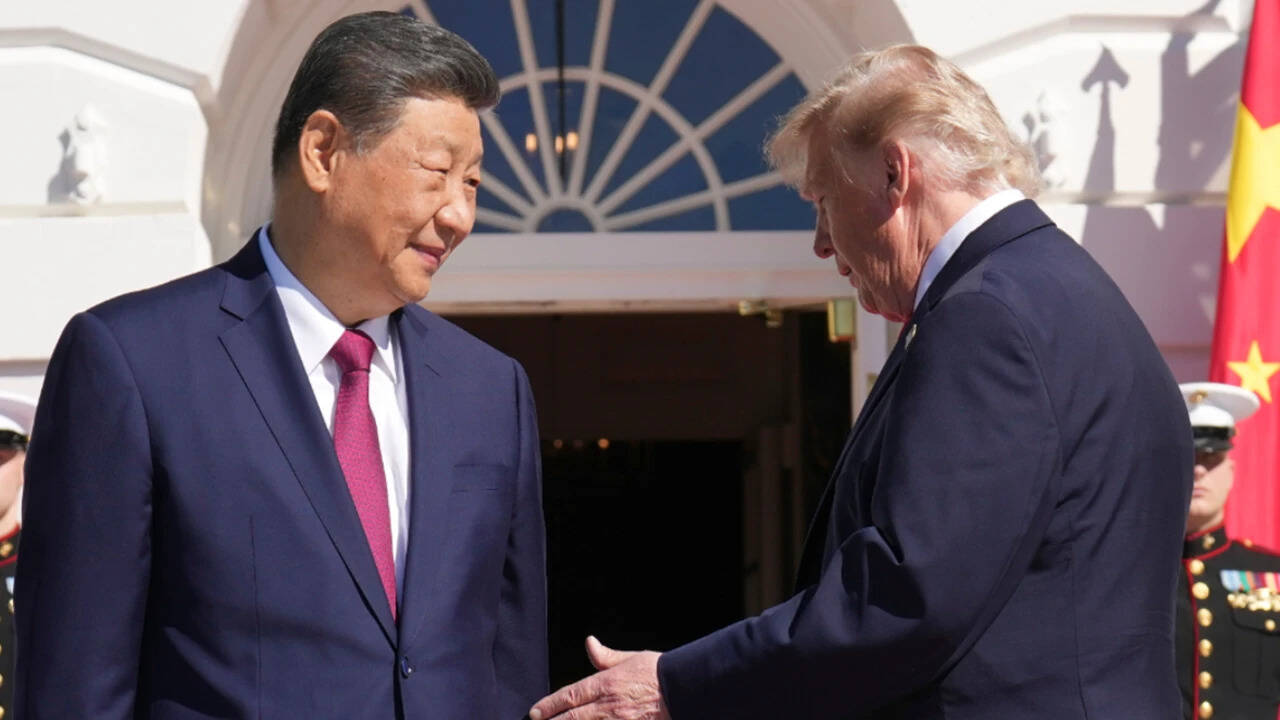
TOI correspondent from Washington: A 48-hour state visit to the United States by China’s President Xi Jinping yielded no immediate major breakthroughs but confirmed the broad impression, in visuals and much as words, that Washington now accepts China as a peer in a new G-2 formulation. For all the talk of trade, artificial intelligence, Taiwan, Iran and strategic competition, the most consequential message of Xi’s visit may have been the choreography itself.
A fawning Trump repeatedly described Xi as a friend and the relationship as a “great friendship,” with little personal reciprocity from the Chinese leader. The charitable explanation for what many critics said was Trump’s folding before Xi and muting his demands from and tirades against China was purportedly in the service of American farmers – his major voting bloc – who are getting screwed because Beijing cut down purchase of soy, corn, and other farm produce.
In brief remarks during a tea ceremony, the MAGA supremo mentioned that the visit had yielded “great results” for American farmers without elaborating, but spoke of little else other than accepting Xi’s invitation to visit China. By most accounts, the summit produced a lot of optics, but little else, amid a cascade of criticism that Trump is placating China rather than confronting it over its actions inimical to US, including its tacit support for Iran.
The most withering censure came from Republican Senator John Kennedy of Louisiana, who likened Xi and leaders of Russia, North Korea and Iran, to reptiles. " The chief reptile, the quarterback, is President Xi.
They all lie like timeshare salesmen. You can’t trust them.
I wouldn’t turn my back on any of them, even if I thought and knew they were two days dead,” Kennedy told a TV show during the visit. Even Senator Chuck Grassley, the Iowa Republican whose state is deeply dependent on agricultural exports, was sceptical about the outcome of the visit, saying that if extending the trade truce was all that emerged, the summit risked becoming a “show job" for a communist autocrat.
On Taiwan, the most sensitive strategic issue between the two sides, there was no public breakthrough. Trump has continued to hold in abeyance a roughly $14 billion Taiwan weapons package that he described earlier this year as a negotiating chip with Beijing.
China wants the arms sales halted; US lawmakers across party lines have urged their release. Nor were there any signs of a significant Chinese concession on Iran.