🔥 TRENDING452 people are currently reading about the Upper Assam Flood Relief efforts⚡ BREAKINGNew IT hub in Guwahati expected to generate 10,000+ jobs by next year🔥 TRENDING452 people are currently reading about the Upper Assam Flood Relief efforts⚡ BREAKINGNew IT hub in Guwahati expected to generate 10,000+ jobs by next year
Congress-NC rift over Vande Mataram: The ghost of 1987 and ‘big brother’ complex | The Local News
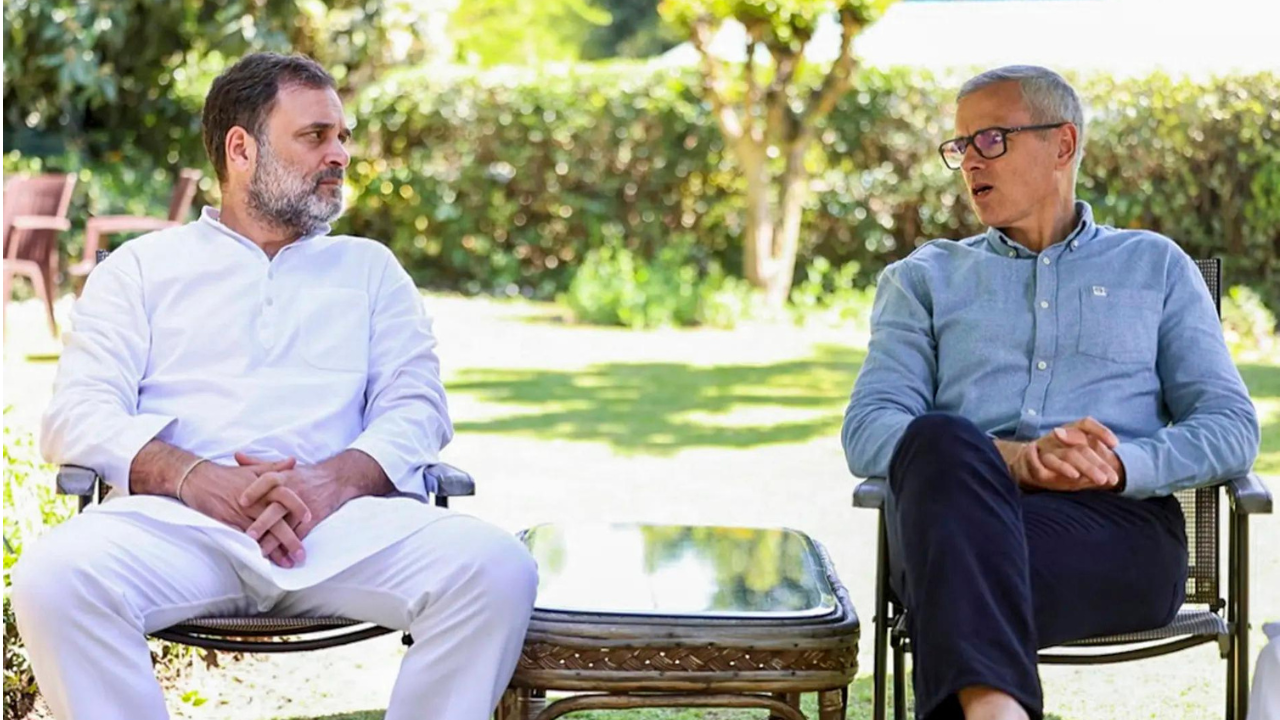
The latest Congress-National Conference (NC) clash may have begun with a song, but it is really about something much older: who gets to set the political terms of the alliance in Jammu and Kashmir? CM Omar Abdullah and NC president Farooq Abdullah stood through the full rendition of Vande Mataram on Wednesday at the inaugural International Film Festival in Srinagar.
The song was played in its complete six-stanza version, lasting about three minutes and 10 seconds, in line with the Centre's new protocol. This was in sharp contrast with the Congress's stand.
Its grand-old party has reaffirmed its 1937 decision to restrict public rendition at party events to the first two stanzas, arguing that the later verses sit uneasily with the pluralist ethos of the freedom movement. Congress general secretary KC Venugopal subsequently said the full version "sits uneasily" with the syncretic and pluralist ethos envisioned by India's freedom fighters and urged allies to stand by the Congress position.
Venugopal called on allies to honour the wisdom of the freedom fightersThe NC was quick to respond, saying the J&K government was only fulfilling its official duty. " After legislative enactment by Parliament, singing Vande Mataram and standing for the song has become a statutory obligation (mandatory legal duty) regardless of the ideological position of any party, group or alliance," said National Conference spokesperson Tanvir Sadiq.
A day later, CM Omar Abdullah also defended the move and said the issue had been needlessly politicised." This is not just for Jammu and Kashmir; it applies to the entire country.
In states governed by the Congress, the same will happen at government functions," he said." This is now a statutory obligation.
Even today, at the closing ceremony, a Union minister will be present. The national anthem will be played there, and the national song will be played too," he added.
The Vande Mataram row is the latest in the list of NC-Congress differences that have surfaced post-election. However, in J&K, the dispute carries an additional historical charge.
The NC has spent decades constructing its political identity around a particular proposition: New Delhi can be a partner, but it cannot be the political proprietor of Kashmir's choices. That is where the ghost of 1987 enters.
One alliance, two political vocabulariesThe Vande Mataram dispute has once again exposed an asymmetry that has repeatedly surfaced between the two parties. Congress has to balance its position across India.
For Abdullahs' NC, the principal political constituency remains rooted in J&K, where questions of identity, autonomy, federalism and the relationship with New Delhi carry a much more immediate electoral meaning. Congress and the National Conference have had a stop-start relationship since 1965 It is also why the latest row is not an isolated irritant in the alliance.
In December 2025, for instance, Omar Abdullah explicitly distanced the NC from Congress's "vote chori" campaign, saying Congress was free to choose its own agenda but that it was not automatically the agenda of the INDIA bloc. With this, Omar tried to assert his party's political autonomy within the alliance.
And that has been the recurring pattern. The alliance and an unequal power equationThe 2024 assembly election gave the NC-Congress relationship a new lease of life, but it also made the asymmetry between the two parties stark.
The alliance crossed the majority mark with 49 seats, with the NC winning 42, Congress six and CPM one. The BJP emerged with 29, PDP three and independents seven.
The campaign also revealed the limits of joint ownership. Congress and NC leaders did not always campaign together.
In Sopore, where the two allies were in a friendly contest, Rahul Gandhi and Omar Abdullah campaigned for their respective candidates separately. During the campaign, Omar Abdullah had publicly noted that Rahul Gandhi should dedicate more campaign time and effort to the Jammu region in addition to Kashmir to maximise electoral impact.
Omar himself gave the practical reason for the alliance during the campaign: it was intended to prevent a hung assembly and give voters an alternative. What Omar Abdullah had said in 2024 The alliance won the election, and the next question was: what does each side get to claim as its own?
The first major post-election rupture came even before the new government had settled in. Omar Abdullah became CM in October 2024, but Congress chose to stay out of his ministry, citing restoration of statehood as its priority.
While Congress backed the NC government from outside, its absence highlighted a strategic divide within the alliance. Omar had to engage with Delhi to govern the Union Territory, while Congress sought to pressure the Centre from outside.
That difference in approach has repeatedly resurfaced. Statehood: Common demand & source of frictionIn July 2025, Congress announced protests in Jammu, Srinagar and Delhi and Rahul Gandhi and Mallikarjun Kharge wrote to PM Narendra Modi seeking legislation to restore J&K's statehood.
The NC leadership was irritated because the announcement had not been coordinated with the ruling party. Some NC leaders described Congress's campaign as counterproductive and even as "sabotage" of the government's own efforts.
Omar's objection was that Congress had launched the campaign without informing or consulting the NC, leaving its alliance partner caught off guard. The difference is clearer on Article 370.
The NC's 2024 manifesto explicitly called for the restoration of Articles 370 and 35A and reversal of the changes made after August 2019. Congress has similarly opposed the 2019 constitutional changes, but in its recent campaigns placed greater emphasis on the restoration of statehood.
Omar reiterated in the J&K assembly in February that his government remained committed to restoring special status, even as statehood remained an immediate demand. By July 2026, he was also linking the restoration of statehood to any future discussion on J&K's earlier constitutional position.
This has given the two parties different political priorities. The Rajya Sabha disputeIn October 2025, the disagreement moved from ideology to seats.
J&K was electing four Rajya Sabha members. The NC, which had emerged as the dominant party in the assembly, initially discussed leaving one seat for Congress.
Talks failed. The NC eventually fielded candidates for all four seats after Congress decided not to contest the fourth seat it had been offered, arguing that it was not among the "safe seats" it had sought.
Omar's response was strikingly matter-of-fact: " So be it." The NC-Congress disagreement ultimately cost the alliance a clean sweep, with the BJP winning the fourth seat Congress had declined to contest.
We felt that the best chance of winning that seat was with the Congress, and they felt otherwise. So be it.
Omar Abdullah on RS seat deadlockThe ghost of 1987 To understand why the NC may be particularly sensitive to questions of control, one has to go back not merely to 1987 but to 1984. Farooq Abdullah's government was dismissed on July 2, 1984, after 12 NC legislators defected.
Ghulam Mohammad Shah, Farooq's brother-in-law and leader of the defecting group, formed the government with Congress support. Contemporary accounts described the episode as a central-government intervention in Kashmir politics; Farooq called the dismissal unconstitutional.
For the NC, this was not an abstract constitutional episode. It was a direct lesson in the vulnerability of a regional government to New Delhi's political machinery.
Then came 1986. Rajiv Gandhi and Farooq Abdullah reached an agreement that brought the two parties together electorally.
1987: The alliance that became a warningThe NC-Congress alliance won 66 of J&K's 76 assembly seats in 1987. But the result was overshadowed by the emergence of the Muslim United Front as an opposition platform, arrests of its candidates and workers, and widespread allegations of electoral rigging.
Human Rights Watch later described the election as a turning point that contributed to widespread disillusionment with electoral politics. The significance of 1987 for the NC, therefore, is about the political memory it created.
A generation of Kashmiri activists came to believe that the democratic route had been closed to them, a perception that became part of the backdrop to the insurgency that followed. The episode also left an enduring paradox.
Congress was simultaneously the NC's electoral partner and a major force at the Centre. That history helps explain the NC's instinct to work with Congress while resisting any perception that Delhi is dictating its regional agenda.
That distrust predates the 1980s. In 1953, Sheikh Abdullah was dismissed and arrested after his relationship with the Union government deteriorated.
The circumstances were very different, but the political memory was similar: central intervention could reshape J&K's politics. 2009-14: History managed, but not erasedThe two parties showed they could overcome that history after the 2008 assembly election.
The NC won 28 seats and Congress 17, and the parties formed a coalition government with Omar Abdullah as CM in 2009. But the partnership remained contested.
Differences over AFSPA, administrative issues and governance repeatedly surfaced. In 2011, Congress called for consensus on AFSPA while Omar maintained that the state government was an important stakeholder.
By 2014, the alliance had run its course and Congress chose to contest the assembly election separately. The 1987 ghost & real test of allianceWhile 1987 may still shape the NC's political instincts, it would be too simplistic to link every present-day disagreement to that history.
The political and constitutional context has changed; however, the experience remains part of the backdrop to the relationship. The lesson for the NC, as we saw in the last election, has not been to avoid Congress, but to work with it where interests converge while retaining its own political space.
The Vande Mataram dispute, therefore, is less significant in itself than what it reveals about continuing differences over statehood, Article 370, seat-sharing and the balance between Congress's national strategy and the NC's regional politics. The alliance can survive such differences, but the interesting question now is how durable it will be, which willdepend on how well the two parties manage their competing political priorities.
Terrence O' Brien is the Verge’s weekend editor. He’s covered the tech industry for over 18 years and knows a thing or two about synths. We don’t know a ton abo...