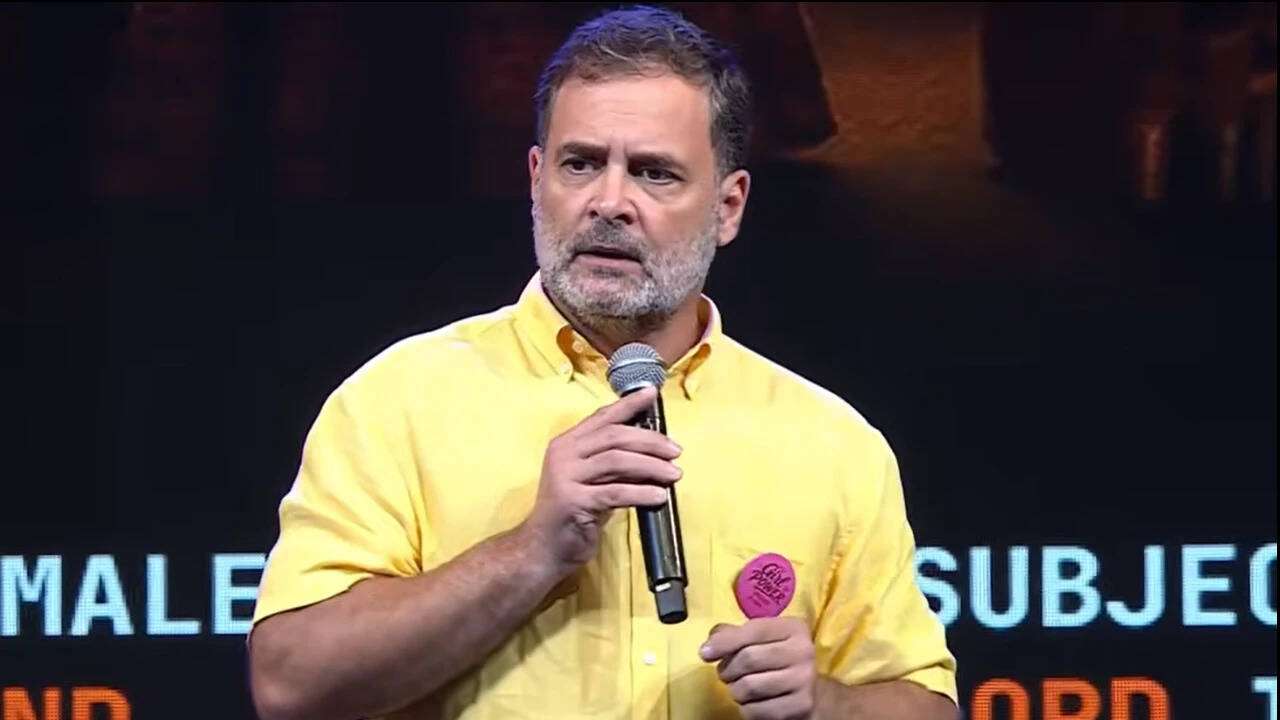
Rejecting the idea of 'manusmriti', he asserted that a woman belongs to no one but herself. NEW DELHI: Congress leader Rahul Gandhi on Friday described India’s 70 crore women as the country’s “biggest asset”, saying they are more forward-looking than men and have a crucial role in shaping the nation’s future.
He also invoked the idea of women's autonomy and said that a woman should have the exclusive ownership of her own life. Speaking at the fourth event of ' Chhatron Ki Goonj' at the AISSMS College Ground in Pune, Maharashtra, he invoked a verse from the Manusmriti and contrasted it with his call for the empowerment and autonomy of women.
Referring to the verse, he highlighted the notion that, “A woman in her childhood belongs to her father, after marriage belongs to her husb and and in her old age belongs to her son.” Rejecting this idea, he asserted that a woman belongs to no one but herself.
While acknowledging that the relationships in a woman’s life are important, he stressed that they do not determine her identity or ownership, which, he said, rests exclusively with her. Speaking on the central theme of the evening, “break the cage”, Rahul Gandhi called on the audience to recognise the individuality that sets each person apart and to resist the pressures that seek to confine them to predetermined identities or expectations.
He said the most important message he wanted people to take away from the evening was a simple but powerful one: “Every single one of you is unique in this universe.” Elaborating on the idea, Rahul Gandhi stressed that individuality is not merely about being different from others, but about recognising one’s own worth and identity.
“You are unique. You are special.
You are an individual,” he told the audience. He emphasised that every person has a distinct way of looking at the world, a different set of aspirations and the ability to imagine a life beyond the boundaries imposed on them.
Rahul further connected this sense of individuality to the freedom to dream and choose one’s own path. “And you have your own dream, your own vision for your life,” he said.
The emphasis, he suggested, was not simply on having dreams, but on having the freedom to define those dreams for oneself rather than allowing society, circumstances or established notions of what one ‘should’ be to determine them. Through the theme of “break the cage”, the LoP framed personal freedom as the ability to step outside these limitations and acknowledge that no individual should be reduced to a role, label or identity prescribed by others.