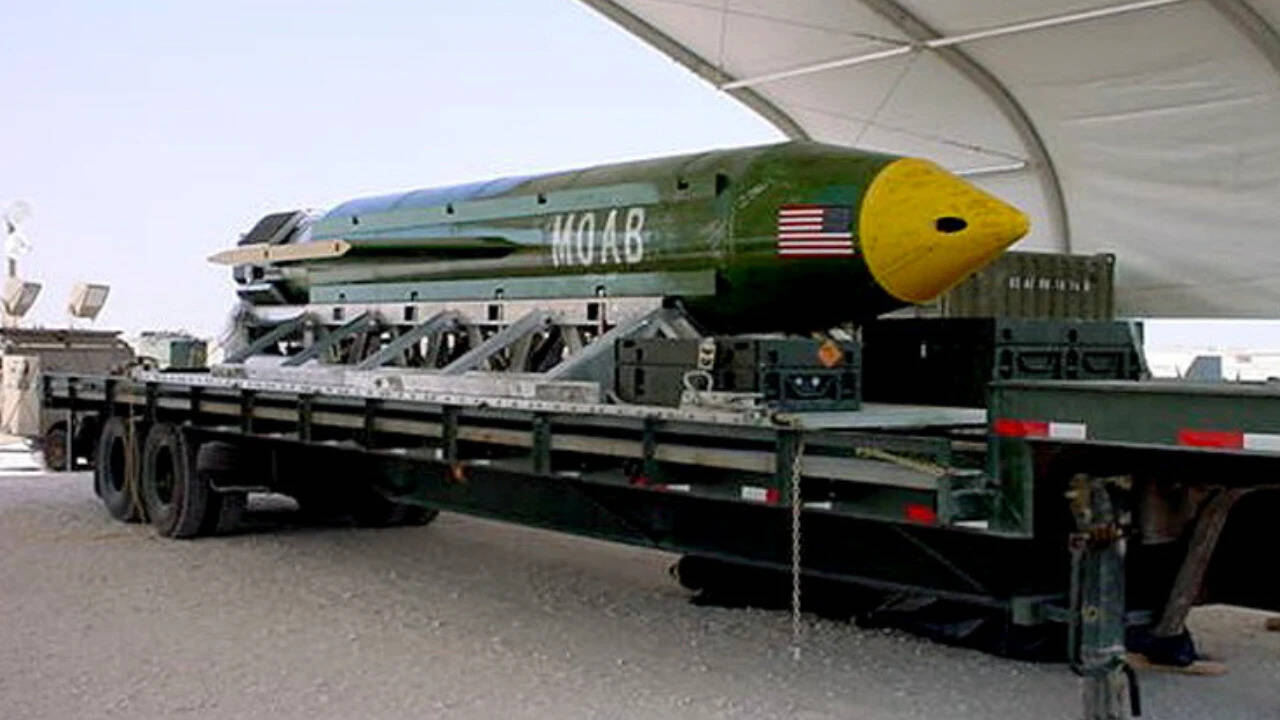
File photo: The GBU-43/B Massive Ordnance Air Blast (MOAB) bomb is pictured in this undated handout photo. The ' Mother of All Bombs' has the name, the weight and the explosive punch.
What it may not have is the right tool for the job the US wants it to do. Reports of possible US discussions about deploying the GBU-43/B Massive Ordnance Air Blast (MOAB) against Iran have put the giant conventional bomb back in focus.
Weighing just under 10,000 kg, it made its combat debut in April 2017 against an Islamic State tunnel complex in Afghanistan, producing the kind of images that cemented its fearsome reputation. But Iran's most important nuclear and military facilities are not sitting ducks in the open.
Many are buried beneath mountains or shielded by reinforced concrete. And the MOAB, despite its enormous explosive power, is an air-burst weapon, not a specialised bunker-buster.
In other words, a spectacular explosion does not necessarily mean a successful strike. Against Iran's deeply buried infrastructure, the bomb's biggest strength could also prove to be its biggest limitation.
A big blast, not a bunker-busterThe central problem is the MOAB's design. Unlike penetrator bombs, which burrow through soil, concrete and rock before detonating, the MOAB is an air-burst weapon that explodes above the surface, spreading a powerful overpressure wave across a wide area.
This makes it effective against personnel and structures in the open, lightly protected infrastructure, cave entrances and exposed military positions. But much of its energy dissipates horizontally rather than downward.
While surface structures can be flattened, heavily fortified underground complexes are far more likely to survive. Iran's most important assets are not housed in vulnerable surface buildings.
Many are concealed beneath mountains and protected by reinforced concrete, meaning the MOAB's explosive power may not translate into the ability to destroy the targets that matter most. An MOAB strike by US may fail to achieve total annihilation or destruction of a target for several key structural, technical, and operational reasons such as inability to penetrate especially in the mountainous terrain with heavy doors which may absorb the blast effect and since the bomb’s lethal over pressure radius could be localised.
Lt Gen KR Rao (retd), Former Director General ArtilleryIran's underground defenceIran's nuclear programme illustrates the challenge. Since the early 2000s, Iranian planners have anticipated that key facilities could be targeted by American or Israeli air strikes.