
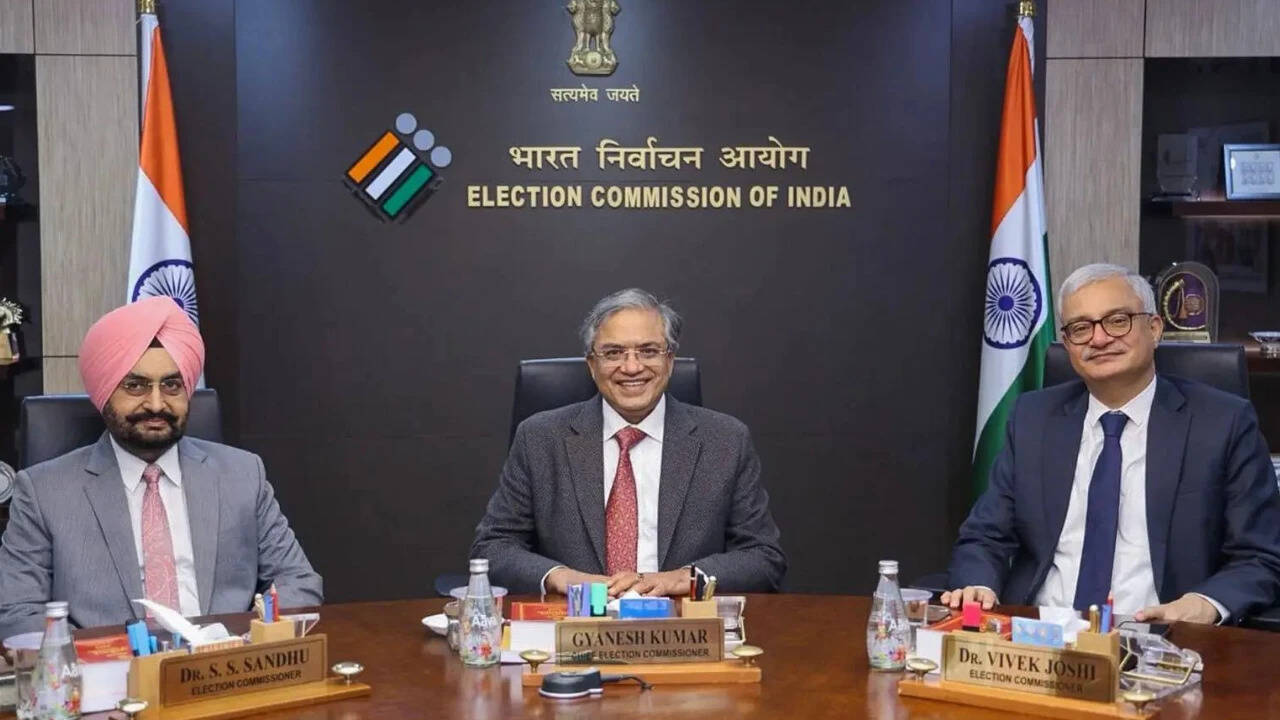
Election commissioners SS Sandhu and Vivek Joshi with Chief Election Commissioner Gyanesh KumarNEW DELHI: Two of three election commissioners, Sukhbir Singh Sandhu and Vivek Joshi, formally objected at least 14 times in 10 months to decisions taken in the full Commission's name, according to an Indian Express report. On Wednesday, a Supreme Court-bench was split on the challenge to the law used to appoint them and asked the CJI to set up a five-judge bench.
1. What exactly are the 2 EC reported to have objected to?
The objections concern some of the most basic functions of election administration. According to the Express investigation, Sandhu and Joshi raised issues involving changes to Form 6, used by new voters seeking registration; deletion and restoration of names during SIR; appeals against decisions restoring voters; and access to and control over the electoral-roll database.
Some notes also questioned communications allegedly issued in the Election Commission's name without approval of the Commission. 2.
Can ECs disagree with one another? Absolutely.
The law explicitly expects that they sometimes will. “As far as possible” is the key phrase here.
But it immediately provides for what happens when unanimity fails: if the CEC and Election Commissioners differ on an issue, the matter is decided according to the majority opinion. With three commissioners, the mathematics is straightforward: 2-1 decides the matter.
3. Is the CEC the boss of the other two?
The CEC unquestionably has an important institutional position, but the other two commissioners are not deputies who simply report to the chief. This question was fought over dramatically during T N Seshan's tenure.
The Supreme Court upheld the creation of a multi-member Election Commission and rejected the idea that the other commissioners were merely ornamental additions. Decisions could legally be taken by majority.
The 2023 law reinforces the collegial structure. It says the Commission's procedure and allocation of business may be regulated through a unanimous decision, while disagreements on substantive matters can be resolved by majority.
So “Chief” does not mean the CEC has an automatic casting vote over two colleagues. 4.