🔥 TRENDING452 people are currently reading about the Upper Assam Flood Relief efforts⚡ BREAKINGNew IT hub in Guwahati expected to generate 10,000+ jobs by next year🔥 TRENDING452 people are currently reading about the Upper Assam Flood Relief efforts⚡ BREAKINGNew IT hub in Guwahati expected to generate 10,000+ jobs by next year
US funded it, China built it at scale: How robot dogs entered new arms race | The Local News
US Army-funded research helped power China’s robot dog boom: How Beijing scaled American technology (Reuters image) China’s Unitree Robotics, one of the world’s leading makers of humanoid and quadruped robots, built some of its most successful robot dogs on technological breakthroughs developed through US military-funded research, according to researchers involved in the programme and a former US defence technology official. The case of Unitree highlights a growing challenge for the United States in the race for advanced military and dual-use technologies: American government-funded research is producing important breakthroughs, but Chinese companies are often proving more effective at turning similar technologies into affordable, mass-produced products.
Unitree’s $1,600 Go2 robot, launched in 2023, helped the company rapidly expand its presence in the global quadruped robot market. The company sold more than 18,000 quadruped robots and 5,500 humanoid robots last year, according to company filings, and was valued at about $9 billion ahead of its stock market debut.
The technology behind Unitree’s popular robot dogs can be traced in part to research funded by the US Army Research Laboratory (ARL), the Defense Advanced Research Projects Agency (DARPA) and other military programmes, researchers and a former US defence technology official told Reuters. The Army-funded programme helped advance key technologies for quadruped robots, including the placement of motors in the legs rather than relying on heavy central gearboxes.
The approach improved a robot’s ability to sense and respond to uneven terrain. Gavin Kenneally, a former University of Pennsylvania researcher involved in the programme, said the Army-funded work became “basically, the first Unitree robot that had any kind of scale."
Ben Katz, who worked at the Massachusetts Institute of Technology’s Biomimetic Robotics Lab, said the dimensions of Unitree’s popular Go series were “to the millimeter” almost identical to Mini Cheetah, a robot he helped develop as part of a consortium of universities funded by US military programmes. Reuters said it was the first media outlet to detail the connections between Unitree’s designs and the US Army-funded research.
How US military research reached ChinaThe US Army funded the Robotics Collaborative Technology Alliance (RCTA) from 2010 to 2020. The programme brought together researchers from government, academia and industry, including the University of Pennsylvania, MIT, Boston Dynamics and NASA’s Jet Propulsion Laboratory.
General Dynamics Land Systems, the Michigan-based defence company that manufactures Abrams M1 tanks, was the alliance’s leading commercial partner. The research built on earlier work funded by DARPA at MIT.
In 2016, University of Pennsylvania researchers, including Kenneally, developed a design that eliminated heavy central gearboxes and instead placed motors directly in the robot’s legs. The change allowed the machines to respond more effectively to terrain and helped advance the development of agile quadruped robots.
In 2019, MIT researchers unveiled the Mini Cheetah, which incorporated features developed at the University of Pennsylvania while adding greater strength and the ability to perform backflips. Katz had published his master's thesis months earlier, detailing the actuators used in Mini Cheetah.
Within six months, he said, Chinese companies were manufacturing copies of the actuators that could be purchased online. Unitree founder Wang Xingxing had already established the company three years earlier.
In his 2016 master's thesis at Shanghai University, which Reuters reviewed, Wang cited MIT's research on the Cheetah and earlier versions of the robot. Wang's thesis also referenced Kenneally's Army-funded research and acknowledged the US laboratory's "pioneering" contributions.
He examined design changes aimed at speeding up development and said the findings could have future "defense, security, family and education" applications. Unitree says on its website that it “independently developed the motors, reducers, controllers, and even some sensors of the quadruped robot.”
Katz said he decided not to commercialise his actuator design because he believed there was not a sufficient market. He said China's ability to manufacture such components quickly had helped advance robotics.
Robotics “has advanced a lot because of the availability of actuators,” Katz said. Joao Ramos, who conducted research alongside Katz at MIT, said Unitree copied the Mini Cheetah's shape, structure and design.
“The actual practical implementation, bringing it to real life, that's all on them,” Ramos said. China turned research into mass-market robotsThe Unitree story points to a wider difference between the US and Chinese approaches to advanced manufacturing.
The United States has maintained a strong position in fundamental research and software, while China has built large industrial clusters capable of producing components at scale and at lower prices. Chinese manufacturers have used extensive supplier networks, component factories and access to critical minerals to expand rapidly in areas including robotics, drones, electric vehicles and solar panels.
Unitree's base in Hangzhou is surrounded by suppliers producing motors, gears, actuators and other components used in robotics. China's dominance in the processing of critical minerals used in robotic magnets has also helped manufacturers reduce costs and accelerate production.
Reyk Knuhtsen, a robotics analyst at SemiAnalysis, described the US failure to commercialise domestic research as a “dropped ball”. S.
to climb,” he said. Jaret Riddick, a former director of the Army Research Laboratory who oversaw the robotics project, said the programme did help kick-start the US quadruped robotics industry.
But without sufficient support for large-scale manufacturing, Unitree in China “just kind of consumed that space.” Unitree now faces US restrictionsThe US government has increasingly moved to restrict Chinese robotics technology on national security grounds.
In June, the Pentagon added Unitree to a list of Chinese military companies, describing it as a “contributor to the Chinese defense industrial base.” The designation does not amount to a direct sanction but restricts the US military's future use of Unitree technology.
In July, the Federal Communications Commission also banned imports of future models of foreign-made humanoid and quadruped robots, including those produced by Unitree. China has threatened retaliation against the FCC move.
The Chinese embassy in Washington defended Chinese companies, saying they were making new technologies more affordable and accessible internationally. It accused the US of “market distortion and unilateral bullying.”
US researchers who spoke to Reuters did not argue that government-funded research should have been kept secret. Instead, they said Washington needs to develop a stronger system for helping domestic companies move discoveries from laboratories into commercial manufacturing.
S. robotics ecosystem” and informed subsequent work across government and the private sector.
ARL also said publication of the research was important for scientific and technological advancement. Vijay Kumar, dean at Penn Engineering, said the US remains strong in innovation and software development but needs greater access to capital, industrial capacity, skilled workers and component supply chains to scale new technologies.
US military also used Chinese robot dogsThe gap between American research and manufacturing capacity has also created an unusual situation in which the US military has itself explored Chinese-made robot dogs. In September 2023, the US Army obtained a federal waiver from rules requiring government agencies to prioritise American-made products to purchase two Unitree Go2 robots, according to procurement records.
The records described the robots as important because sufficient US-produced alternatives of “a satisfactory quality" were not available. Reuters could not establish whether the purchases were completed.
The US military has also experimented with weaponising quadruped robots. In September 2023, US Marines conducted an exercise involving a Go1 robot fitted with a rocket launcher for remote firing.
Chinese military exercises have similarly featured robot dogs. Chinese state television has shown Unitree Go2 robots operating alongside People's Liberation Army troops.
Another modified Unitree B1 robot has been shown firing a mounted assault rifle. Unitree has maintained that its products are intended for civilian use.
In 2022, the company joined US robotics firms in signing an open letter pledging not to weaponise robots, citing the risks of harm and serious ethical concerns. Walking robots are not yet widely deployed on battlefields, but both the US and China are examining their potential for military applications, including surveillance, reconnaissance and operations in difficult terrain.
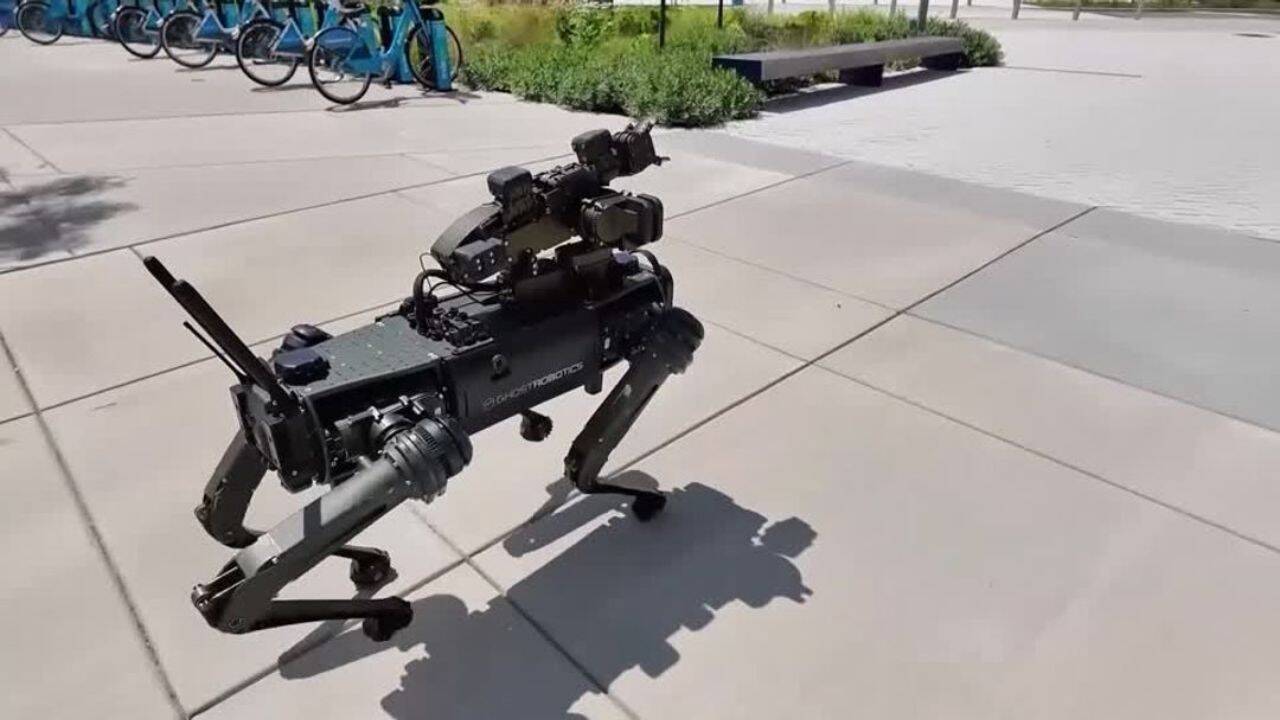
US defence robots remain far more expensiveAmerican companies continue to produce military-grade quadruped robots, but at substantially higher prices and smaller volumes. Kenneally's Ghost Robotics has supplied about 1,000 Vision 60 robots, mainly to military and government customers for surveillance and search operations in harsh environments.
Its first customer was Navy Special Warfare Command, which oversees Navy SEAL teams. Ghost Robotics has also faced challenges in reducing its dependence on Chinese components.
Some components of its robots are manufactured in China, although the company has been shifting its supply chain. The company moved its motor supply from China to South Korea two years ago but continues to face difficulties replacing Chinese magnets and certain metal components, according to Kenneally.
In 2024, South Korean defence company LIG Defense & Aerospace acquired a 60% stake in Ghost Robotics for $240 million. The company is also exploring production in Taiwan.
“We need to work closely with our allies,” he said. “There's absolutely no path forward without them.”
China’s industrial strategy widens the gapChina's advantage in robotics is not limited to individual companies. It is linked to a broader industrial policy that has channelled capital into advanced manufacturing.
In 2015, Chinese President Xi Jinping announced a 10-year strategy aimed at establishing Chinese leadership in industries including robotics, electric vehicles and green energy. Since then, Chinese companies have benefited from access to capital, dense manufacturing networks and suppliers capable of producing components at scale.
The approach has allowed companies to tolerate lower margins while expanding production and market share. S.
and Chinese robotics companies,” he said. S.
companies and China’s coordinated national strategy.” For Washington, the challenge is now how to ensure that government-funded breakthroughs do not remain confined to research laboratories while companies in China turn similar technologies into cheaper products at scale.
The Pentagon has declined to comment on Unitree's commercialisation of US Army-funded research. The White House did not respond to requests for comment on US industrial policy.
The episode underlines a wider concern for US defence planners: maintaining an edge in military technology may depend not only on producing breakthrough research, but also on building the industrial capacity needed to manufacture those technologies quickly, cheaply and at scale.
Guwahati: Prof. Sudhakar Nadkarni, a pioneer of design education in India who helped establish the Department of Design at the Indian Institute of Technology (I...