🔥 TRENDING452 people are currently reading about the Upper Assam Flood Relief efforts⚡ BREAKINGNew IT hub in Guwahati expected to generate 10,000+ jobs by next year🔥 TRENDING452 people are currently reading about the Upper Assam Flood Relief efforts⚡ BREAKINGNew IT hub in Guwahati expected to generate 10,000+ jobs by next year
The China+1 question: Does India lose if Trump and Xi make peace? | The Local News
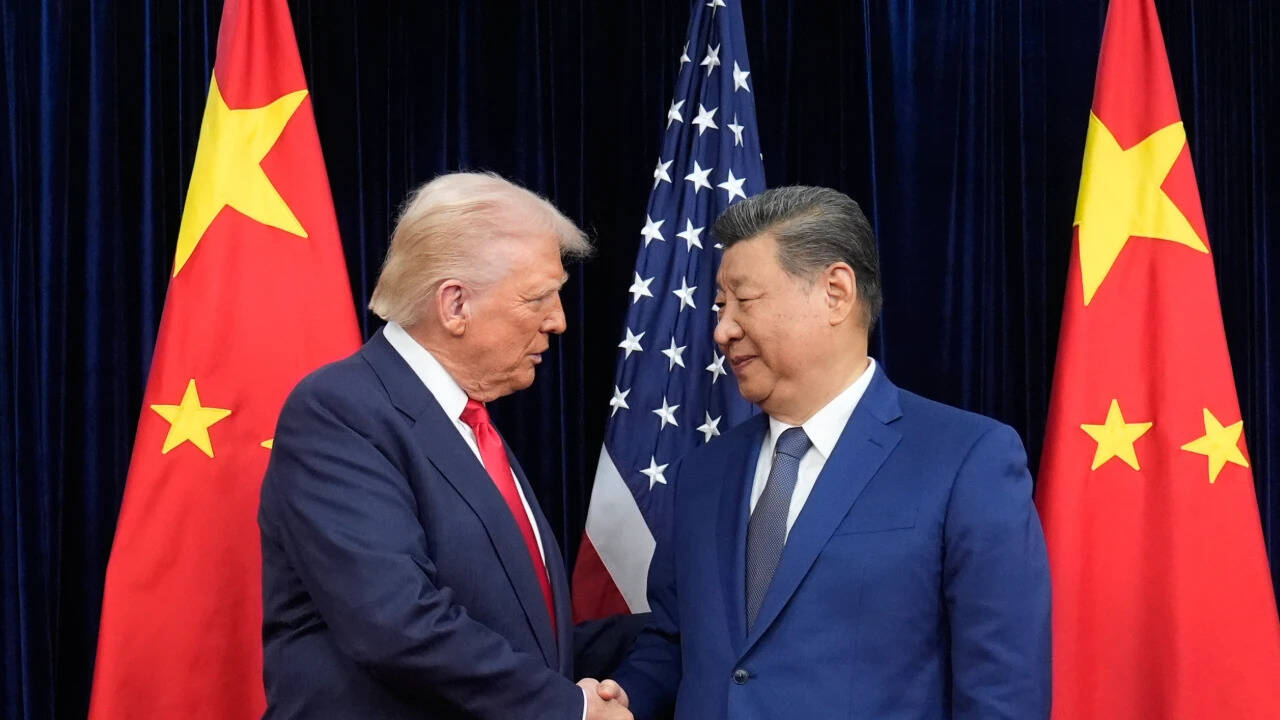
Trump-Xi summit puts tariffs, AI, rare earths and Taiwan in focusChinese President Xi Jinping arrives in Washington on September 23 for a three-day state visit. When US President Donald Trump welcomes Xi to the White House, the two leaders will have plenty to talk about: tariffs, artificial intelligence, rare earths, Taiwan and Iran.
India will not be on the agenda. But it will have plenty at stake.
Driving the news: From trade war to uneasy truceUS-China tensions have produced tariffs, technology restrictions and an accelerating effort by Western governments and companies to reduce their dependence on Chinese supply chains. China has a stranglehold of rare earths and critical minerals.
Xi demonstrated that he has a “Trump” card in US-China relations. When Beijing restricted exports amid its confrontation with Washington, the Trump admin had to make a retreat.
That leverage appears to have changed Washington's calculations. This is why the Trump administration has taken a less combative approach ahead of this summit, with analysts pointing to America's vulnerability to Chinese restrictions on critical minerals.
For now, both are trying to manage competition. And that distinction matters enormously to India.
Why it matters: India has been one of the beneficiaries of the great decouplingThe US-China rivalry has created many opportunities for India. Global companies began looking for a “China+1”.
Supply-chain resilience became a national-security priority. The Quad acquired greater strategic relevance.
But even if Washington and Beijing find a sustainable way of doing business while continuing to compete, India's fundamental advantages remain. India is a large democracy, a potential manufacturing alternative to China, a technology power and an Indo-Pacific state capable of helping balance Beijing.
But what could change is the urgency with which others seek them. Here are 5 Indian interests worth watching.
Zoom in: What happens to China+1 if China becomes less risky? India's manufacturing opportunity has been one of the clearest dividends from US-China tensions.
The logic of China+1 was never that companies would abandon China altogether. It was that relying almost entirely on one manufacturing ecosystem had become too dangerous.
India cashed on it. The PLI scheme sought to attract investment in electronics, telecom equipment, pharmaceuticals and other industries.
Electronics production expanded. Apple's suppliers increased their Indian footprint.
US-China rivalry boosted India's mobile manufacturing, but a thaw could intensify competitionBut consider what happens if US-China relations become more predictable. China still possesses something India cannot replicate overnight: Gigantic supplier networks, world-class infrastructure, skilled labour, ports and manufacturing clusters built over decades.
If geopolitical risk falls, the premium companies are prepared to pay to manufacture elsewhere could fall with it. That doesn't mean factories return to China.
Covid alone taught global companies the value of diversification. 2.
Chips and AI: What if the technology wall develops doors? Semiconductors have become the defining battlefield of the US-China competition.
Washington has spent years restricting Chinese access to advanced chips and manufacturing technology. India, meanwhile, has positioned itself as a trusted technology partner.
The US-India TRUST initiative now encompasses semiconductors, AI, quantum technology, critical minerals, biotechnology, energy and space. It also envisages an AI infrastructure roadmap intended to accelerate US-origin AI investment and infrastructure in India.
But AI is also on the Trump-Xi agenda. The two sides are exploring ways of managing risks from increasingly powerful AI models, although Washington remains committed to maintaining its technological advantage.
China would also like relief from some US technology restrictions. A summit will not dismantle America's technology controls.
However, if Washington permits more “non-sensitive” technology commerce with China, US companies regain access to an enormous market and Chinese firms gain additional room to operate. India's proposition consequently has to evolve from “choose us because China is unavailable” to “choose us because India is indispensable.”
3. Rare earths: The minerals underneath the handshakeRare earths may be the most important part of the summit that most people have never heard of.
They are essential to EV motors, wind turbines, electronics, chips and advanced weapons. And China dominates their processing.
That dependence gives Beijing an extraordinarily effective form of economic leverage. It also creates an opening for India.
India and the US have already signed a Strategic Critical Minerals Cooperation Framework covering mining, processing, recycling, financing and resilient supply chains. India is separately developing rare-earth corridors in Odisha, Kerala, Andhra Pradesh and Tamil Nadu.
But urgency is important. China's critical-mineral dominance gives Beijing major leverage over global supply chainsThe more insecure Washington feels about Chinese supplies, the stronger the incentive to finance alternatives.
4. Russia and Iran: Watch what exemptions China getsThen there is energy.
India and China are both major purchasers of energy from countries Washington wants to isolate. The Trump administration wants Beijing to reduce purchases of Iranian oil, while US pressure over Russian energy has placed India in the firing line as well.
Iran is expected to feature in the Trump-Xi discussions. What if Beijing receives exemptions, tariff relief or other concessions as part of a wider bargain while India faces tougher treatment for pursuing its own energy interests?
5. The Quad: Does India matter less when China looks less threatening?
The biggest question is strategic rather than economic. The rise of the Quad - India, US, Japan and Australia - cannot be separated from anxiety about China's growing influence across the Indo-Pacific.
Yet a US-China detente does not make India's concerns about China disappear. Beijing's relationship with Pakistan remains.
Competition across the Indian Ocean remains. Taiwan and the South China Sea remain potential flashpoints.
And even amid the US-China thaw, Washington and New Delhi have continued building mechanisms explicitly intended to diversify critical-mineral and technology supply chains. The US-India critical-minerals framework signed this year is already in force.
So the Quad isn't about to disappear. But its political relevance could diminish.
India cannot outsource its rise to US-China rivalryIndia should hardly wish for a US-China confrontation. A trade war between the world's two largest economies would damage the global growth.
India's advantages remain formidable: Scale, demographics, geography, technological talent, military weight and a huge domestic market. But those advantages ultimately have to stand on their own.
India's task is to make sure its geopolitical value doesn't depend on how well or badly those two men get along.
Guwahati: Police and local residents seized five firearms and 13 rounds of live ammunition in two separate incidents in Assam’s Golaghat and Kamrup districts, w...