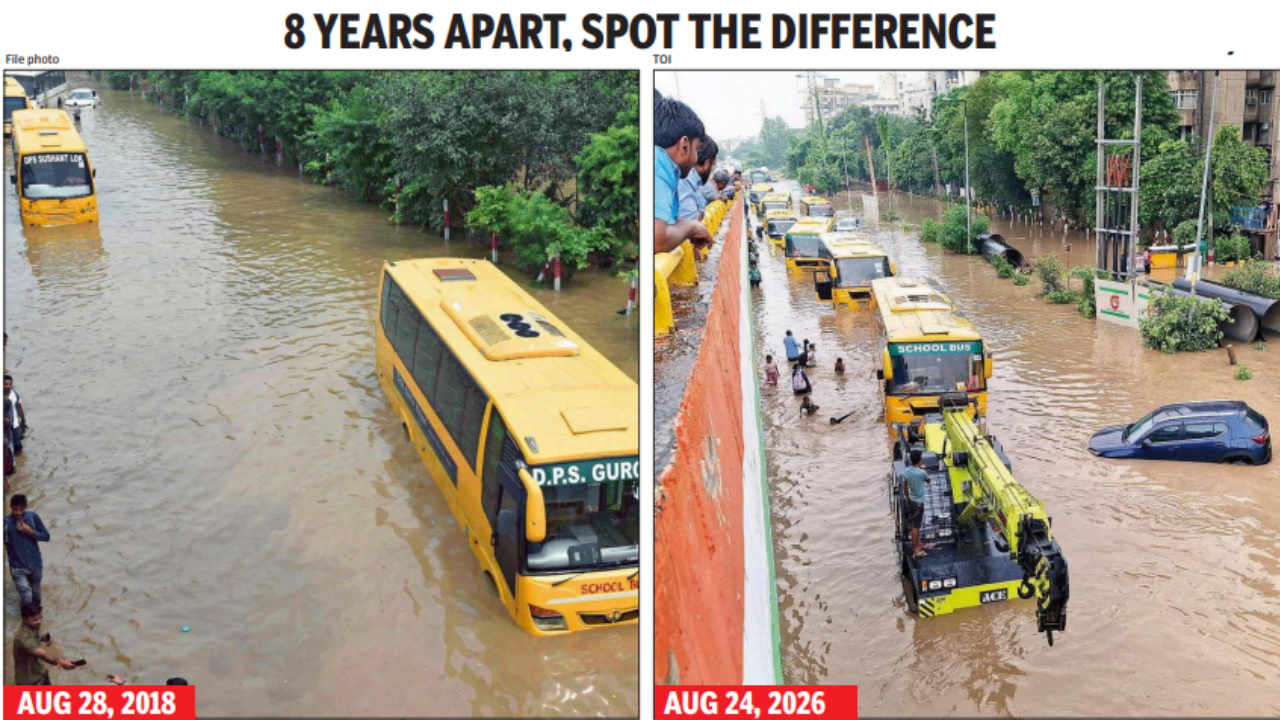
The city's yearly cycle has become depressingly predictableGURGAON: Gurgaon's Monday monsoon disruption exposes a recurring infrastructure failure, with 75mm of rain flooding major roads, stranding schoolchildren and commuters, and causing missed trains. Hundreds of crores spent on drainage and desilting, along with pending road repairs and major civic body vacancies, show a city repeatedly treating symptoms, not building long-term resilience.
When a spell of rain becomes a stress test for a cityParents were seen wading to the buses to get their children out and carry them back on their lapsGurgaon recorded about 75mm of rain between 8am and 5pm on Monday, but the impact was far greater than the rain figure suggests. Major corridors like Sohna Road, Golf Course Road, MG Road, Delhi-Gurgaon Expressway, Rajiv Chowk, Hero Honda Chowk, IFFCO Chowk and Udyog Vihar were waterlogged, and traffic came to a standstill.
The most troubling evidence wasn't in traffic statistics, but in school buses. 5 feet of water to reach them.
30 pm. Tax-paying parents had one simple question: why is rain an emergency?
The economic toll is just as real, but it's rarely found in a city budget. 10 pm train from New Delhi Railway Station had intentionally kept a margin of three hours.
But after almost two hours, the cab had covered only 500 meters on Sohna Road. He had to give up on the road journey and, eventually, the train itself.
This is infrastructure failure as residents see it: lost hours of work, missed trains, expense and disruption to business, and delays that are not their fault. The money is spent.
So why does the problem come back? Rs 503 cr spent on drainage infrastructureThis is perhaps the most uncomfortable question for Gurgaon.
A recent assessment noted that the administration has spent close to Rs 503 crore over the last nine years, up to 2025, on improving the city's drainage infrastructure. But an hour of heavy rain was enough to bring large parts of the Millennium City to a standstill again.
So it's no longer just a question of money being spent — it's a question of whether public spending is addressing the underlying engineering problem, or merely funding another round of emergency pumping, desilting, patching and road repairs. There were warning signs before the week began.