
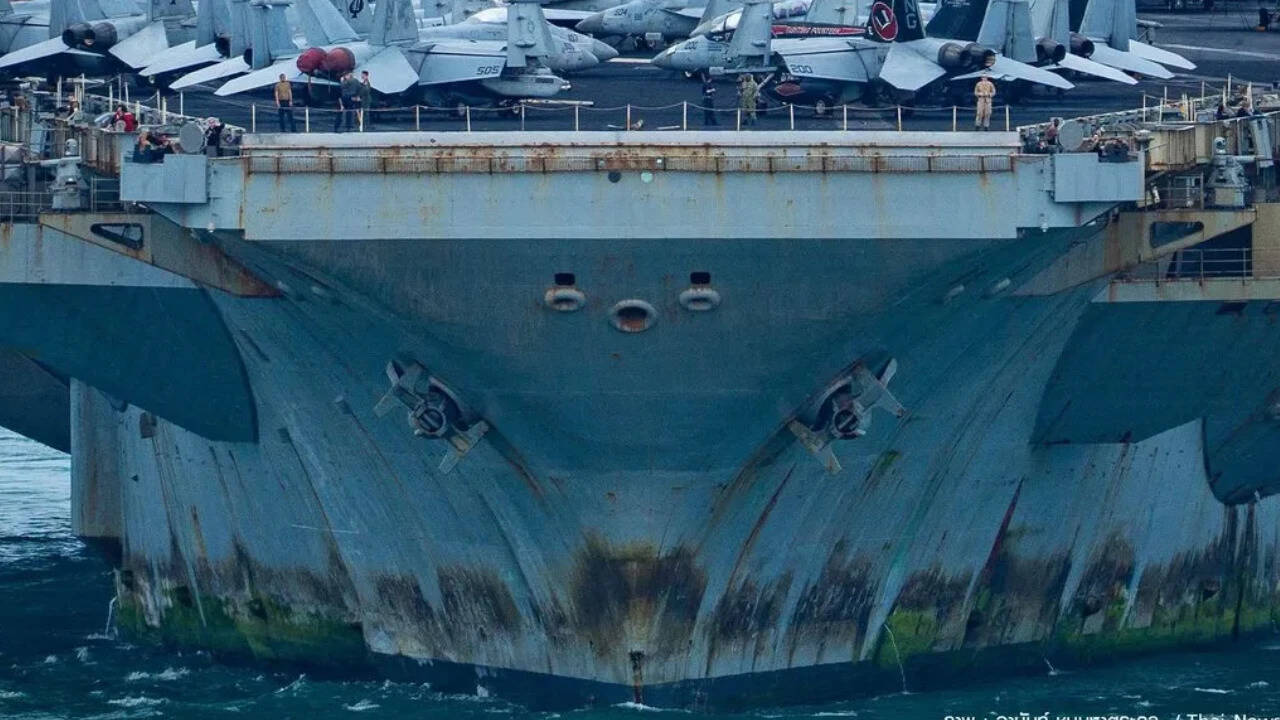
A weathered and rusted USS Abraham Lincoln docks in Thailand for maintainanceA rusted and worn USS Abraham Lincoln arrived in Thailand after an extraordinary 286 days of deployment at sea. The carrier shows visible signs of wear and tear, its hull streaked with rust and its paint visibly weathered after months of combat and blockade operations in the Middle East.
The appearance of the US Navy's nuclear-powered aircraft carrier serves as a visual record of its extended deployment and long overdue need for maintenance. Naval experts say prolonged exposure to seawater, humidity and heavy operational activity can leave even major warships visibly weathered when there is little opportunity for routine preservation work.
The Lincoln, which carries roughly 5,000 sailors and Marines, entered Laem Chabang port on Wednesday after leaving its homeport of San Diego on November 21, 2025. The carrier had spent much of its deployment in the Middle East, where it participated in US operations against Iran, including naval blockade and combat missions.
286 days at seaUS naval deployments typically last between six and nine months, although they can be extended considerably during wartime. The Lincoln's deployment stretched the upper limit.
According to reporting by Reuters, the carrier had one uninterrupted stretch of around 286 days at sea, described as a modern-era operational record by Democratic lawmakers. Its strike group was eventually relieved by the USS George Washington, allowing the Lincoln to begin its return journey.
The prolonged deployment placed considerable demands on the carrier and its accompanying vessels. Reuters photographs showed not only the Lincoln but also the guided-missile destroyer USS Frank E.
Petersen Jr. and cruiser USS Robert Smalls with visible rust and mottled paint around their waterlines.
That suggests the deterioration was not unique to the carrier but part of the broader wear accumulated by ships operating continuously in a harsh maritime environment. Carl Schuster, a former US Navy captain who served aboard Nimitz-class carriers, told CNN that rust along the waterline was not unusual after extended periods at sea.
Removing it requires crews to work close to the waterline, sand away corrosion and apply multiple layers of protective coating, work that is difficult to undertake while a ship is actively deployed. Rust itself does not establish a loss of combat capability, but corrosion control requires time, manpower and maintenance capacity.