🔥 TRENDING452 people are currently reading about the Upper Assam Flood Relief efforts⚡ BREAKINGNew IT hub in Guwahati expected to generate 10,000+ jobs by next year🔥 TRENDING452 people are currently reading about the Upper Assam Flood Relief efforts⚡ BREAKINGNew IT hub in Guwahati expected to generate 10,000+ jobs by next year
Putin's party wins again as expected. So why does Russia still hold elections? | The Local News
Why does Russia hold elections if Putin is bound to winRussians went to the polls. The votes were counted.
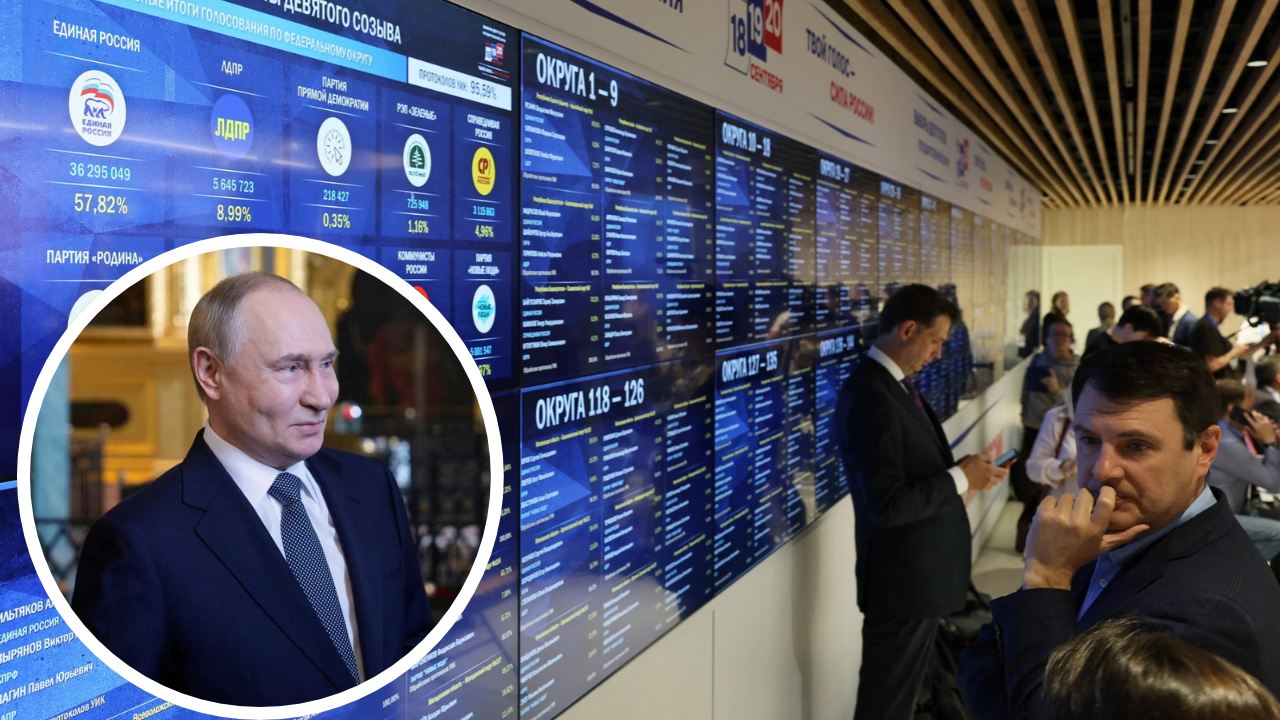
Russian President Putin's party United Russia won again, and comfortably. The result itself was hardly the mystery.
The more interesting question is why Russia still goes through the elaborate business of elections when the system makes a genuine change of power extremely unlikely. Because in Russia, an election may not simply be about choosing who governs.
It can also tell the Kremlin who is turning up, where support is weakening, which regional leaders can deliver and how well the machinery is working. But first, a simpler question: does a Russian vote actually matter?
83% of the vote, according to Russia's Central Election Commission, with more than 95% of ballots counted. The result gives United Russia 355 of the 450 seats in the State Duma, preserving its constitutional majority.
8% of the vote. The election was also the first parliamentary vote since Russia launched its full-scale invasion of Ukraine in 2022.
Putin had presented it as a test of support for his policies and the war. The Kremlin said the first parliamentary election since Moscow sent troops to Ukraine in 2022 showed Russians were united around Putin, who has been in power since New Year's Eve 1999.
That raises an obvious question: If Russia is widely described as an authoritarian or 'managed' political system, and the Kremlin is not seriously threatened by an opposition party taking power, why bother holding elections at all? Putin’s United Russia party has won 355 of the 450 seats in the State Duma.
Does a Russian vote actually matter? It would be too simplistic to say that an individual vote is completely meaningless simply because the ruling party is expected to win.
Formally, an individual Russian vote can affect the composition of the Duma in two ways. Half of the 450 seats are distributed through nationwide party-list proportional representation, with a 5% threshold, while the other 225 are elected from single-member constituencies.
“In the party-list contest, one vote is a very small part of the national total, although collectively these votes determine 225 seats and can be particularly important when a party is near the 5% threshold,” explained foreign affairs expert Robinder Sachdev. “In a close constituency race, however, a relatively small number of votes can directly determine who wins that seat,” explained foreign expert he added.
The 2026 result illustrates how strongly the constituency component can amplify a party's parliamentary strength. United Russia won 355 of the 450 seats, up from 343 in the previous Duma and the party's highest total so far.
That gives the party well over the two-thirds threshold in the Duma. “So an individual vote has limited weight by itself, but aggregated votes — particularly in single-member constituencies — can have a major effect on the parliamentary balance of power,” Sachdev said.
Does the vote count actually matter? In the narrowest sense, yes.
Russians cast ballots, those ballots are counted and the resulting numbers determine how parliamentary seats are allocated. 83% vote share is therefore not simply a number that has no connection whatsoever to voting.
But whether voters have a meaningful opportunity to change who exercises power is a different question. Russia's political system has placed significant restrictions on genuine electoral competition.
Reuters described the 2026 parliamentary election as taking place in a “tightly controlled political system” in which candidates opposed to Moscow's war in Ukraine have largely been excluded. Several parties besides United Russia are represented in the Duma, but Russia's parliamentary opposition operates within tightly drawn limits, with the major parties generally supporting Putin on key issues, including the war in Ukraine.
According to the Center for European Policy Analysis (CEPA), Yabloko, a liberal party that opposed the Ukraine war and called for a ceasefire, was excluded from the federal parliamentary contest. 2% in the 2021 election.
Meanwhile, Putin critic Nikolai Bondarenko had already been barred from standing. Putin has been in power since New Year's Eve 1999.
So should this be called a gimmick? Not quite.
Even when the broad political outcome is predictable, elections can serve several purposes for an authoritarian political system. “Elections also help manage the political system itself,” Sachdev said, adding that they provide opportunities to renew parliament, accommodate different groups within the governing establishment and assess the performance of regional political organisations and officials.
“The Kremlin may already have extensive polling and administrative data, but an actual election reveals the geography, intensity and organisational strength of support across the country,” he said. In other words, the Kremlin does not necessarily need an election to disc over who rules Russia.
1. An election creates a claim of public supportThe first and most obvious purpose is legitimacy.
The Kremlin can point to an electoral result and say that millions of Russians participated and that the governing party received a majority of votes. That does not settle the question of whether the election was free and fair.
But politically, the existence of an official vote gives the government a concrete result with which to demonstrate public backing. This election is particularly significant because it took place during the war in Ukraine.
The Kremlin has an interest in demonstrating that the war has not produced a political revolt at home. Sachdev said the election allows the Russian leadership to “demonstrate a measurable level of public participation and support”, even if the broader political outcome is predictable.
That distinction is important. 2.
It gives the Kremlin a measure of support — even if an imperfect oneThis is where the question of whether votes “count” becomes more complicated. Even in a tightly controlled election, authorities can learn something from participation.
How many people turn out? Where is turnout unusually low?
Which regions deliver particularly strong support? Where does United Russia perform worse than expected?
Are local officials able to mobilise their populations? These are valuable pieces of information for an authoritarian government.
A 2021 Carnegie analysis described Russian parliamentary elections as functioning less as contests over who would govern and more as a mechanism for measuring and demonstrating support for Putin's system. ”“Turnout, abstention, regional variations and the performance of individual candidates can reveal where support is strong, where enthusiasm is weaker, and how effectively governors and local political organisations are able to mobilise voters,” he said.
More over, information moving upwards through a political hierarchy can be filtered, because officials may have incentives to report favourable results to their superiors. Sachdev said an election can therefore provide an additional dataset against which those reports can be assessed.
“Political-science research describes this as a ‘fire alarm’ function of elections,” he said. So the election does not simply measure public opinion.
It gives the Kremlin a regional picture of both political sentiment and the effectiveness of the state and party machinery in mobilising voters. 3.
Elections keep political elites in lineThere is another audience for Russian elections that is often overlooked: the people inside the system. An election allows governors, mayors, party officials and other local power brokers to demonstrate that they can deliver the results expected by Moscow.
Carnegie has described regional elections in Russia as an “initiation ritual” for governors and local elites — an opportunity for them to demonstrate control over their territories. Sachdev said regional leaders are expected not only to administer their territories but also to maintain political stability and demonstrate an ability to mobilise electoral support.
Research on Russian regional politics has found that United Russia has historically performed better where governors command effective political organisations and local networks, he said. This means an election can function almost like an internal performance review.
If a governor produces the desired result, it demonstrates political control. If a region suddenly records unexpectedly weak support for the ruling party, that can raise questions in Moscow about the governor's popularity, the effectiveness of the regional administration, the strength of the local party organisation or underlying economic and social dissatisfaction.
An unexpectedly poor result would not automatically lead to a governor's removal. But, Sachdev said, electoral underperformance “can weaken a regional leader's standing with the federal centre” and become one factor in subsequent decisions about appointments, tenure or political advancement.
4. It gives voters a controlled way to participateThere is also a social function.
Russia's government does not necessarily want every citizen to become politically disengaged. Voting gives people a formal mechanism for expressing preferences, even if the range of choices is restricted.
The question is not necessarily whether the Kremlin believes Russians are choosing between two equally viable governments. Rather, elections can allow the system to channel political participation without allowing that participation to threaten the basic distribution of power.
Sachdev said elections also help “renew the composition of parliament” and accommodate different groups within the governing establishment. 5.
Elections can reveal dissatisfaction — but not necessarily change the governmentThis is perhaps the most counterintuitive part. A controlled election can still contain information about dissatisfaction.
People can abstain. They can spoil ballots.
They can vote for smaller parties or candidates. They can use whatever limited electoral choices are available to signal disagreement.
Russia's political opposition has previously tried to use elections tactically to weaken United Russia, even when it could not realistically replace the Kremlin. But the ability to express dissatisfaction and the ability to translate that dissatisfaction into a change of government are two different things which is why the Kremlin may tolerate a certain degree of electoral competition while drawing firm limits around the political system.
So, is the result meaningless? Not necessarily.
The official vote count is meaningful as a description of what Russia's electoral authorities say happened. But the number cannot be read in isolation as a straightforward measure of Russians' freely expressed political preferences.
The composition of the ballot matters. So does who was permitted to campaign, what political views could be openly expressed, the degree of media access available to competing forces, turnout and the broader electoral environment.
This creates the central paradox of Russia's elections - The votes can be real without the contest being genuinely competitive. A Russian voter can make a choice.
But the political system determines, to a significant extent, which choices are available in the first place. 83% figure needs to be read carefully.
83% of all Russians freely chose Putin's political system.
Goldman Sachs and BNP Paribas on Tuesday divested a combined 68.33 lakh shares of BSE worth Rs 2,186.44 crore through bulk deals on the NSE, ahead of the stock...