
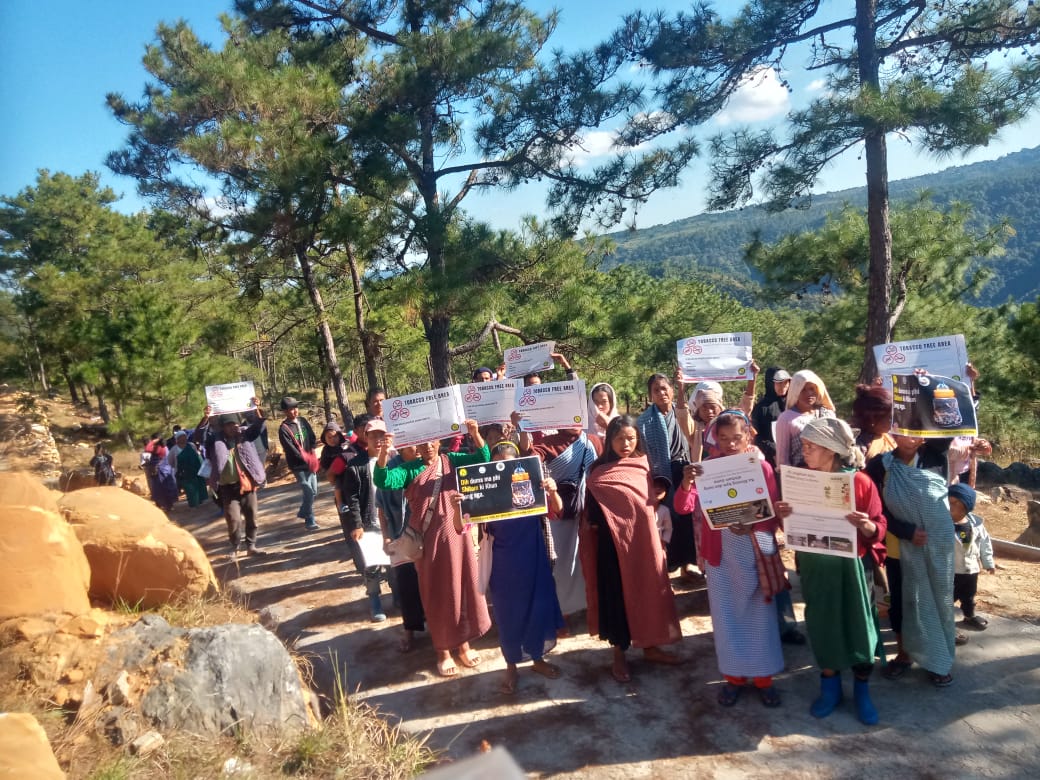
September 2026: Meghalaya is emerging as a powerful example for the Northeast in the fight against tobacco, with 531 (41%) Village Health Councils (VHCs)—community platforms that bring villagers together to address local health issues—achieving Tobacco-Free status in two districts through the Tobacco-Free Village (TfV) Programme. Currently implemented across East Khasi Hills and West Jaintia Hills, the programme has 1,039 (80%) VHCs actively participating, with Tobacco-Free VHCs more than doubling from 264 to 531 over two years.
The achievement comes against the backdrop of a high tobacco burden across the Northeast.
6% nationally.
Tobacco is also a major contributor to the region’s cancer burden, particularly oral cancers.
Recognising the need for stronger community-level action, the Ministry of Health & Family Welfare (MoHFW) has urged communities to work towards tobacco-free villages and issued Standard Operating Procedures (SOPs) for villages to be Tobacco Free in 2024. Meghalaya had already initiated in this direction to the ground, translating the call for Tobacco-Free villages into sustained community action.
A key strength of Meghalaya’s TfV model is that Tobacco-Free status is not simply a declaration, it is achieved through community action and verified compliance. Communities undertake activities including appointing TfV Nodal Officers, conducting awareness activities, adopting resolutions, promoting tobacco-free public spaces and restricting tobacco sales around schools.
A VHC achieves Tobacco-Free status after successfully completing and demonstrating at least five of six prescribed activities, verified through the programme’s monitoring process. In fact, during the programme’s first year, senior officials from the Ministry of Health & Family Welfare and the World Health Organization visited participating villages and were immensely impressed with the community-driven approach.
The impact is increasingly visible beyond the numbers.
More than 6,372 anti-tobacco activities have engaged 54,956 community members, bringing tobacco-relate.
Appreciating the efforts of the villagers and TfV Nodal Officer, the VHC Chairperson of Mawmluh VHC in Shella Block said that they have observed a 40–50% reduction in tobacco use in public places and a 60–70% reduction in smoking inside homes, especially around children.
Dr. Nabaneeta D.
Mawrie, State Nodal Officer, National Tobacco Control Programme, NHM Meghalaya, said: “The Tobacco-Free Village programme in Meghalaya involves action by the villagers such as talking about tobacco issues in the village in gatherings, SHG meetings, etc. The increasing number of VHCs implementing activities and achieving verified Tobacco-Free status reflects how tobacco control is becoming an increasingly shared responsibility among communities.
The Programme on the ground started as a pilot in two districts and will be expanded to the entire state.”
The TfV programme is one of the tobacco-control initiatives in Meghalaya.
The Government of Meghalaya is also implementing other tobacco control Programmes like Tobacco-Free Educational Institutions (ToFEI) and COTPA (Cigarettes and Other Tobacco Products Act) enforcement, which have demonstrated strong outcomes in the state.
Sambandh Health Foundation brings together technology, community mobilisation, training, data-driven monitoring, etc, through its unique Digital Program Implementation (DPI) methodology, enabling public-health programmes to be implemented efficiently, at scale and with measurable impact.
With the Northeast carrying some of India’s highest tobacco prevalence, Meghalaya’s experience demonstrates how tobacco control can move from policy to sustained community action. The combination of community-led implementation and a scalable DPI methodology offers a practical approach that can be adapted across Northeastern states to strengthen tobacco-control programmes and help reduce the region’s tobacco burden.