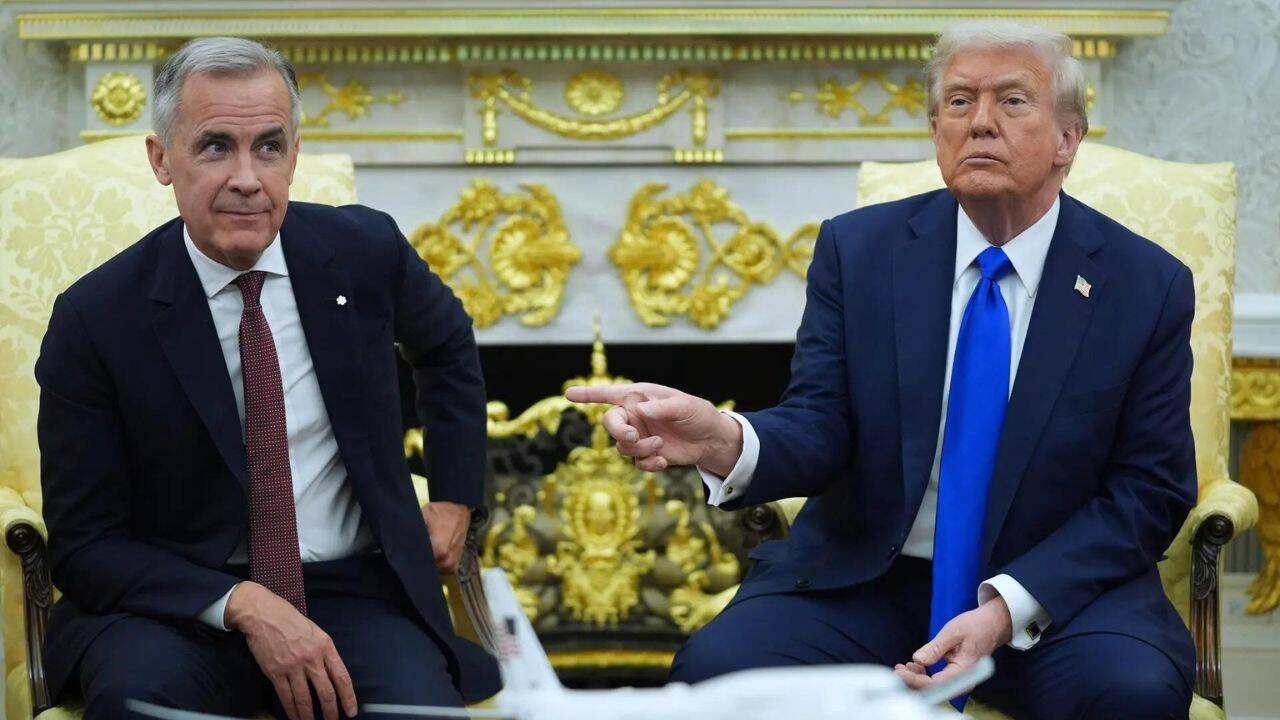
Carney claimed that Trump’s demands are reaching beyond tariffs into the country’s national identity and sovereignty. (AP Photo) TOI correspondent From Washington: Canada has long been seen as America’s best friend, even sibling: close enough to borrow sugar (or maple syrup) from, harmless enough to tease with quips like how the country is like a loft apartment over a great party (Robin Williams) and “I don’t even know what street Canada is on” (Al Capone).
Even a looming trade war did not dull the humour. Now, Prime Minister Mark Carney says US President Donald Trump is embarking on something rather more serious and provocative than demanding better access for American dairy farmers: he wants to change Canada culturally and linguistically.
“We were ready and close to having a comprehensive agreement that would be fair to both countries. But they made changes, including threats on the French language and Quebec culture and Canadian culture.
That is not acceptable,” Carney said in remarks that revealed the trade war between the two countries is no longer merely a fight over who pays more for cheese; it is becoming a quarrel over what it means to be Canadian. It is quite a transformation for two countries whose economies are so intertwined that distinguishing where an American product ends and a Canadian one begins can require the services of a forensic accountant.
The latest escalation arrived Saturday, when Trump imposed 50% tariffs on roughly $20 billion of Canadian imports. Canada responded with the economic equivalent of saying, If you insist on bringing a knife to dinner, we have cutlery too, promising a “dollar-for-dollar” retaliation from September 8 targeting American steel, dairy, appliances, agricultural equipment and other goods.
The damage is fairly modest because the new American tariffs cover only about 5% of Canadian exports to the US -- small beer in a $900-billion per year trade relationship. But the psychological bill is immense.
For generations, Americans have treated Canada as the reassuringly sensible friend or sibling — the place where people speak English, French and, apparently, apologize in both languages. The stereotypical American view has been that Canadians are essentially Americans who say “sorry” more often.
Not anymore; Trump’s “51st state” rhetoric has helped turn that gentle stereotype upside down. Carney is now arguing that Canada must no longer assume geography automatically guarantees prosperity and security.