
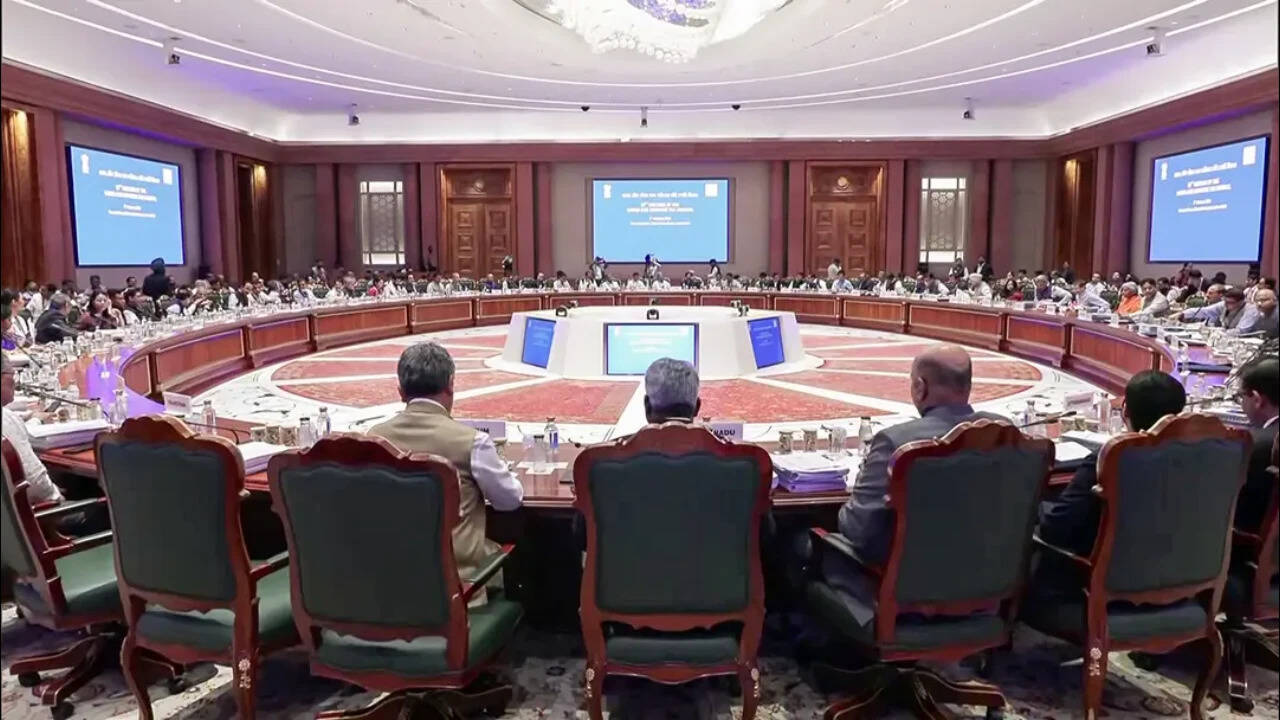
A view of the 57th Goods and Services Tax (GST) Council Meeting, chaired by Union Finance Minister Nirmala Sitharaman, in New Delhi on ThursdayNEW DELHI: Nine years after the biggest indirect reform in the country, GST Council on Friday decided on a massive procedural overhaul that will rework the way businesses operate, enable them to get refunds and credit for taxes paid, allow for movement of trucks with fewer stoppages and do away with officers' arrest powers. 0 was completed with the elements to be rolled out from April, allowing for amendments to the law and for the systems to be revamped.
Amid the unanimity at the all-powerful body led by finance minister Nirmala Sitharaman, there were two subjects on which decisions were deferred. First, the proposal to only stop input tax credit (ITC) for entities that have collected tax, but not deposited it, while allowing it for others in the chain to claim credit was referred to a panel of officers.
The committee has been tasked with finalising its recommendations and coming back to the Council within three months so that it can be ready by April, Sitharaman told reporters after the six-hour meeting. Focus on faster decisions, lower compliance costs: PMPM Narendra Modi, in a social media post, said, “The Council’s recommendations on removal of arrest provisions, greater decriminalisation and simpler procedures will have a very positive impact.
The focus is clear: Faster decisions. Lower compliance costs.
Automated refunds. Trust-based administration.
These are in line with our constant efforts to make GST more efficient, transparent and citizen-friendly.” After the meeting, Sitharaman said states and the Centre have worked together to move to a trust-based regime for taxpayers.
One of the most significant changes is to do away with arrest powers for officers under section 69 of Central GST (CGST) Act. While the powers were not available under the VAT regime, the threat of arrest has often been dangled by officials.
Separately, the monetary threshold for prosecution has also been raised five-fold to Rs 5 crore, while also rationalising punishment under section 132 of CGST Act. Even dispute resolution has been reformed with the Council deciding against issuing notices in cases where the tax involved is under Rs 10,000.
What’s more, even in the ongoing 12 lakh-odd cases, notices will be withdrawn. Further, while penalties will be deemed to be a “charge”, where tax is paid voluntarily, in non-fraud cases a reduced penalty of 5% will be imposed if the interest is paid within 30 days or 60 days in case of adjudication.


