🔥 TRENDING452 people are currently reading about the Upper Assam Flood Relief efforts⚡ BREAKINGNew IT hub in Guwahati expected to generate 10,000+ jobs by next year🔥 TRENDING452 people are currently reading about the Upper Assam Flood Relief efforts⚡ BREAKINGNew IT hub in Guwahati expected to generate 10,000+ jobs by next year
From caste & salary to 'vibe check': How India's marriage biodata is evolving | The Local News
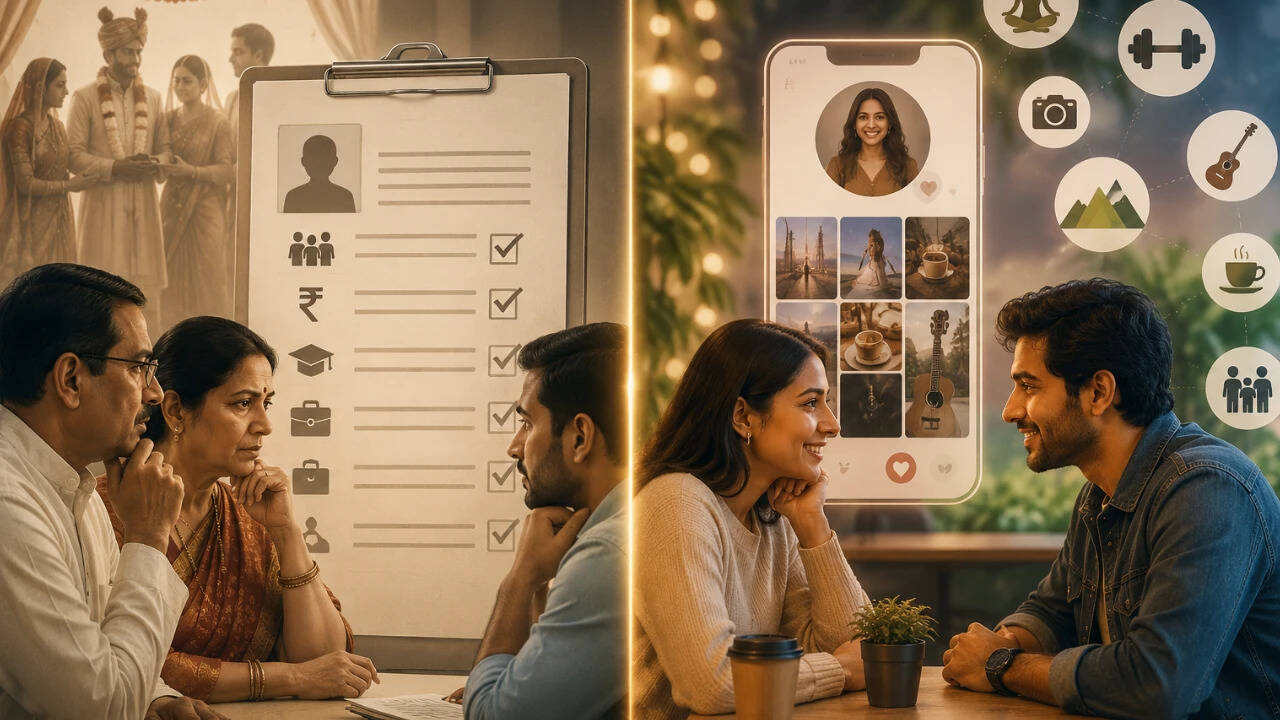
(AI image) Every year, India witnesses a familiar wave - the marriage season. Wedding halls fill up, families revive old contacts, matrimonial apps see a surge, and somewhere between the “ladka kya karta hai?”
”, the search for a perfect match begins. in.
Amid the rituals, celebrations and matchmaking conversations comes a quieter ritual: the biodata. What looks like a simple one-page profile is, in fact, a snapshot of a changing India, reflecting what families still look for, what young Indians now expect from a partner and how the idea of a “good match” is being rewritten.
The old marriage checklistFor years, a marriage biodata followed an almost predictable template: age, height, complexion, caste, salary and family background. For women, descriptions such as “fair”, “homely” and “well-mannered” were not unusual.
For men, a stable job, income, property and family status often carried considerable weight. Recalling her experience, 52-year-old Mamata from Uttar Pradesh, told TOI these factors continue to play a major role in rural areas, although expectations have evolved as one moves towards urban India.
). The girl’s family wasn’t really allowed to ask questions to the other side.
That used to be a very awkward conversation,” she said. “My daughter has her own perspective and priorities.
If parents of my generation were looking for a match for her, we would consider the factors I mentioned above. But those things may not matter to my daughter because she is working and living abroad,” she said.
The difference, then, may not simply be about what appears on a biodata. It is also about who gets to decide what matters.
What’s changed, and what hasn’tSo, has the marriage biodata itself really changed? Not really.
“Honestly, the biodata format itself hasn't changed much because what needs to change is the mindset of the people creating them. That kind of change is hard, but it's the only way forward.
And the people who are willing to evolve their biodata are the ones finding better matches,” she said. Relationship coach Sidhharrth S Kumaar of NumroVani sees the shift less in the document itself and more in its purpose.
According to him, the question is gradually moving from “Is this family socially suitable?” to “Can these two individuals realistically build a life together?”
He also points to a change in who controls the process. “Parents use the biodata to reduce social uncertainty, while their children use it to reduce relationship uncertainty,” noted Kumaar.
That distinction captures one of the biggest changes in the modern marriage search. Verona Matchmaking, another platform TOI spoke to, points to another broader shift: the changing role of courtship itself.
Young Indians increasingly want the opportunity to date, spend time together and genuinely get to know each other before deciding to marry. Which was yesnot a case earlier.
But there is an interesting contradiction. As people become better at describing exactly what they want in a partner, there is also a risk of becoming too good at filtering people out.
Verona Matchmaking therefore emphasises the importance of keeping an open mind during the process. The objective, it suggests, “should not be to find someone who perfectly matches every item on a checklist, but to find someone worth getting to know.”
From 'fitting in' to 'fitting together' For people currently looking for a partner, the shift is increasingly visible in the questions they ask. Rupali Rani, an account manager at The Reppro who is currently looking for a match, told TOI that financial stability is important but no longer enough.
“For me, financial stability is only one part of the picture. I want to know how a person thinks, communicates, treats people and looks at life.
I would rather have a good conversation with someone and realise that our values align than tick ten boxes on a biodata and then struggle to have a conversation in real life,” she said. For Rani, the change is particularly visible in what women expect from marriage.
“It is now less about ‘Will you fit into my family?’ “I would rather have an uncomfortable conversation in the beginning than a comfortable misunderstanding that becomes a problem later.
My career, my lifestyle and my independence are important to me. Of course, being in a relationship means making adjustments; both people will have to.
But adjustment and compromise are not the same thing,” she added. Data cited by the National Center for Biotechnology Information (NCBI) also points to broader changes in women’s lives.
In India, efforts to delay girls’ marriage have contributed to a decline in marriages before the age of 18, from 47% in 2006 to 23% in 2019-2021. The other sideBut women aren't the only ones rewriting the rules of modern matchmaking.
Men, too, are pushing back against transactional evaluations in search of genuine emotional alignment. Shivam Sharma, who is currently looking for a match, told TOI that questions about his CTC, job, property, family responsibilities and career plans are common, particularly from the prospective bride’s family.
“Someone may have a very high salary or own properties worth crores, but that doesn't guarantee that he will be a good husb and, that he will bring happiness to his partner, or that the relationship will be free from dishonesty or conflicts,” he said. Instead, Sharma believes families should also ask about a man’s ambitions, values, work ethic, financial plans and how he views his responsibilities towards his family.
“Both families may still be involved, but ultimately, the decision is increasingly being left to the two people who are actually going to spend their lives together. I think that is an important and positive change,” he said.
Traditional expectations from women, however, have not disappeared. “For me, good nature, mutual understanding, compatibility and family values matter much more than someone's appearance,” he said.
“If she wants to travel, spend time with her friends, watch a movie, go on a long drive or pursue something that makes her happy, I don't think marriage should stop her from doing those things. She should have her own space and freedom, just as I would expect to have mine,” he said.
“Marriage should involve adjustments from both sides, not sacrifices expected from only one person,” Sharma said. Biodata vs personFor those who have gone through matchmaking, the importance of a biodata can look different in hindsight.
What seems important while searching for a partner may not always matter once two people begin building a life together. Vaibhavi Srivastava, an assistant account manager in corporate communications and PR, and Prakhar Mathur, a software test engineer, are now married.
Speaking to TOI, they shared what they looked for in each other's biodatas and how their idea of a “good match” has evolved. PollWhich aspect do you believe should hold more weight in a biodata?
Physical appearancePersonality traitsFinancial statusCultural compatibility3k+ users shared opinion today 5k+ users already voted today Share OpinionSrivastava focused more on the individual than the family. She looked for educational qualifications, career, future plans and a progressive, open-minded partner who would support her ambitions.
A relatively small family was also a preference. Mathur initially considered age, but soon focused on personality, education and career goals.
For both, compatibility and mutual support mattered more than ticking boxes. “Real priorities will come to the fore during a conversation about your way of communication and your view of life,” he said.
Neither considered caste or family status deciding factors. Ultimately, they said, the relationship is between the two people getting married.
The old checklist is evolving … slowlyYet the shift towards compatibility does not mean the traditional marriage checklist has disappeared. Caste, complexion, height, income and family background continue to influence partner selection, though their importance varies across families and generations.
Sharma believes caste still matters, but the barrier is thinner than it was for his parents' generation. “I don't think caste has disappeared, but I do think compatibility, understanding and individual choice are becoming more important,” he said, adding that marriage decisions are increasingly about the two people rather than their caste backgrounds.
Rani sees a similar transition. “We are in a transition phase.
The old checklist hasn't disappeared; it has simply started sharing space with a new one,” she said. Ankur Gola, a resident of Delhi, who recently got married, told TOI, “my family was on board with whoever I'm considering but there was an orthodox condition that person should not be of lower cast or muslim; which was difficult for me to accept as they never taught me to discriminate against people...
I decided to break the cycle.” New words, old biases Sidhharrth Kumaar takes the argument a step further.
He believes traditional factors have not necessarily disappeared, they have sometimes simply been given newer names. Caste, he said, may be described as “cultural compatibility” or “similar traditions”.
“These expressions are not inherently discriminatory, but they can camouflage older preferences. The language of matchmaking has modernised faster than the underlying selection criteria,” he said.
The transition, therefore, is not a clean break from the past. The big pictureThe traditional one-page marriage biodata is no longer confined to a printed sheet passed between relatives, family friends or neighbours.
Increasingly, matchmaking has moved online, with profiles becoming searchable, editable and instantly shareable. That has changed the reach of the biodata.
What once travelled through a limited family or community network can now be shared far beyond it, sometimes with hundreds or thousands of potential matches. Yet technology has not necessarily erased tradition.
Instead, the old checklist has found a new home online. A profile can still ask about caste, family, profession and income, even as it increasingly includes interests, lifestyle, career aspirations and expectations from a partner.
The format has become digital. The conversation around it is becoming more personal.
And perhaps that is the real evolution of the Indian marriage biodata. It is no longer only asking, “Is this person suitable for our family?”
Increasingly, the question is becoming:“Can these two people build a life that works for both of them?” The biodata may still fit on one page.
But the definition of a “good match” is getting much bigger.
Riyadh airport blast triggers flight suspensions by Air India, Akasa Air and IndiGoNEW DELHI: Air India, Akasa Air and IndiGo have temporarily suspended or curt...