
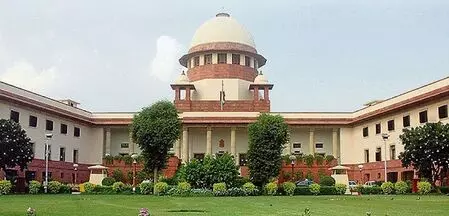
New Delhi, Aug 20: The Supreme Court on Thursday ruled by a 6:3 majority that the expansive definition of “industry” laid down in its landmark 1978 judgment cannot be used to interpret the Industrial Relations Code, 2020. A nine-judge Constitution bench headed by Chief Justice Surya Kant, however, held that the reference seeking reconsideration of the 1978 judgment on the meaning of “industry” was validly made.
The bench was examining the legal position established by the Supreme Court in the Bangalore Water Supply and Sewerage Board case in 1978, which significantly widened the scope of what could be treated as an “industry” under the Industrial Disputes Act, 1947. What did the court rule?
Chief Justice Surya Kant, who authored the majority judgment along with Justices Satish Chandra Sharma, Alok Aradhe and Vipul M Pancholi, made it clear that the “triple test” evolved in the 1978 judgment remains valid. However, the test will apply only to pending labour-related cases under the now-repealed Industrial Disputes Act, 1947.
The majority also clarified that the 1978 principles cannot automatically be carried over to the Industrial Relations Code, 2020. Cases arising under the new law will have to be decided independently, based on their facts and circumstances.
" The majority has held that the reference is valid and we have made it abundantly clear that the majority will apply prospectively and the pending matters (under the ID Act of 1947) will be adjudicated as per the triple test definition under the Bangalore Water Supply (1978 judgement)," the CJI said. He added that the principles laid down in the 1978 verdict "shall not be considered as a sweeping anchor for the interpretation of the 2020 Act and its interpretation will be considered independently".
Detailed judgments are awaited. What is the ‘triple test’?
The triple test, evolved by Justice V R Krishna Iyer in the 1978 judgment, broadly says that a systematic activity involving cooperation between employers and employees for the production or distribution of goods and services can qualify as an “industry”. The broad interpretation brought a large range of workplaces and institutions within the protective framework of the Industrial Disputes Act, including hospitals, educational institutions, clubs and government welfare departments.
The judgment had consequently extended statutory labour protections to millions of workers across sectors. What did the minority judges say?