
Indonesia earthquake: At least 38 killed, buildings collapse as aftershocks rattle region
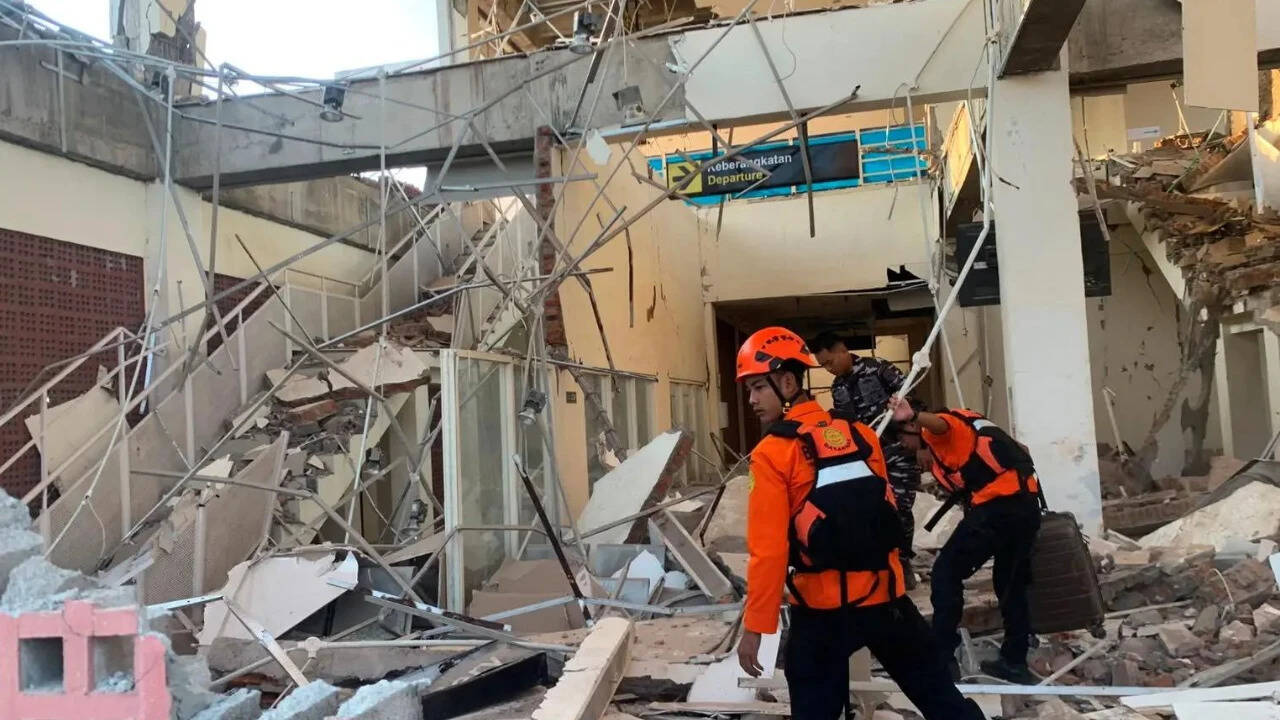
Rescuers inspect a heavily-damaged building (Reuters image)At least 38 people were killed after a powerful magnitude 7.7 earthquake struck off Indonesia's Flores island on Saturday, with buildings collapsing, landslides blocking roads and rescue operations continuing across the worst-hit areas.The quake also triggered a tsunami warning that was later lifted after authorities found no significant sea-level changes.Death toll rises to 38The earthquake has killed at least 38 people, BNPB chief Suharyanto told reporters, revising earlier casualty figures as rescue teams recovered more victims from affected areas. The quake struck off eastern Indonesia early Saturday and caused widespread damage across parts of Flores.Earlier, rescuers had reported recovering at least 20 bodies from Sikka, West Manggarai and East Manggarai, including eight people killed in a landslide in Reok village. Six injured people were taken to hospitals, while two villagers were initially reported missing after being buried by landslide debris.Buildings collapse, landslides block roadsThe powerful tremor damaged homes and public buildings across Flores, with footage showing collapsed structures and residents fleeing their homes. Landslides triggered by the earthquake also blocked the Trans-Flores highway, a roughly 700-kilometre road linking Labuan Bajo and Larantuka.East Nusa Tenggara Police Chief Rudi Darmoko said communication disruptions and power outages had complicated the collection of casualty and damage reports.“We are continuing to collect reports of damage and casualties, but there are communication disruptions,” Darmoko said.Rescuers were also searching areas where landslides had buried people under mud and debris.2,000 residents evacuatedAround 2,000 residents in Nagekeo regency fled their homes and moved to temporary shelters following the earthquake.The BNPB also deployed a helicopter to support logistics and emergency response operations, including possible evacuations. The aerial support is particularly important in East Nusa Tenggara, where the island geography can make access to affected areas difficult.Tsunami warning liftedAuthorities initially issued a tsunami warning for parts of East Nusa Tenggara, West Nusa Tenggara, South Sulawesi and Southeast Sulawesi and urged residents near beaches and riverbanks to move to higher ground.The warning was later lifted after Indonesia's Meteorology, Climatology and Geophysics Agency found no significant sea-level changes posing a continuing threat to coastal communities. Tsunami waves of less than one metre were recorded before the warning was cancelled.Multiple aftershocks rattle regionThe magnitude 7.7 earthquake was followed by numerous aftershocks, with strong shaking felt across Flores and neighbouring areas.The US Geological Survey said the main earthquake struck at a shallow depth of about 10 kilometres, around 68 kilometres north-northwest of Ende in East Nusa Tenggara province. The shallow depth contributed to strong shaking and damage across the region.India's National Centre for Seismology also recorded a series of powerful earthquakes in the region, including tremors of magnitude 7.4, 6.3 and 6.0.Hospitals evacuate patientsThe earthquake forced several hospitals to move patients and medical equipment outdoors as a precaution after buildings were damaged.Footage showed hospital staff moving beds, IV stands and oxygen cylinders outside and setting up temporary treatment areas. The emergency arrangements were put in place as authorities assessed the structural safety of medical facilities.Trans-Flores highway cut offLandslides in Ende regency blocked sections of the Trans-Flores highway, disrupting a key road link across the island.The road stretches for around 700 kilometres from Labuan Bajo to Larantuka and connects several communities across Flores. The disruption has complicated access for emergency responders and the movement of supplies.Residents describe destructionYohanna Embu, a resident of Sikka regency, said strong shaking damaged several buildings and prompted people to move towards higher ground.“Many buildings here were damaged ... I saw that the waiting room at the port terminal in Maumere had collapsed,” she said.At St Peter Major Seminary in Sikka, students attending morning Mass fled after the roof of an assembly hall collapsed, according to Rev Guidelbertus Tanga, the seminary's rector.“Our students and nuns ran out in panic beneath a collapsing roof,” Tanga said. “At least one priest suffered a broken leg after jumping from the second floor of a building during the quake.”Indonesia remains highly earthquake-proneThe disaster has again exposed Indonesia's vulnerability to major earthquakes and tsunamis. The archipelago lies along the Pacific "Ring of Fire", where several tectonic plates meet, making the country prone to frequent seismic and volcanic activity.Flores was hit by a devastating earthquake and tsunami in 1992 that killed around 2,500 people. Indonesia also suffered a magnitude 7.5 earthquake and tsunami in 2018 that killed more than 4,400 people, while the 2004 magnitude 9.1 earthquake off Sumatra triggered a tsunami that killed around 230,000 people across countries bordering the Indian Ocean.


