
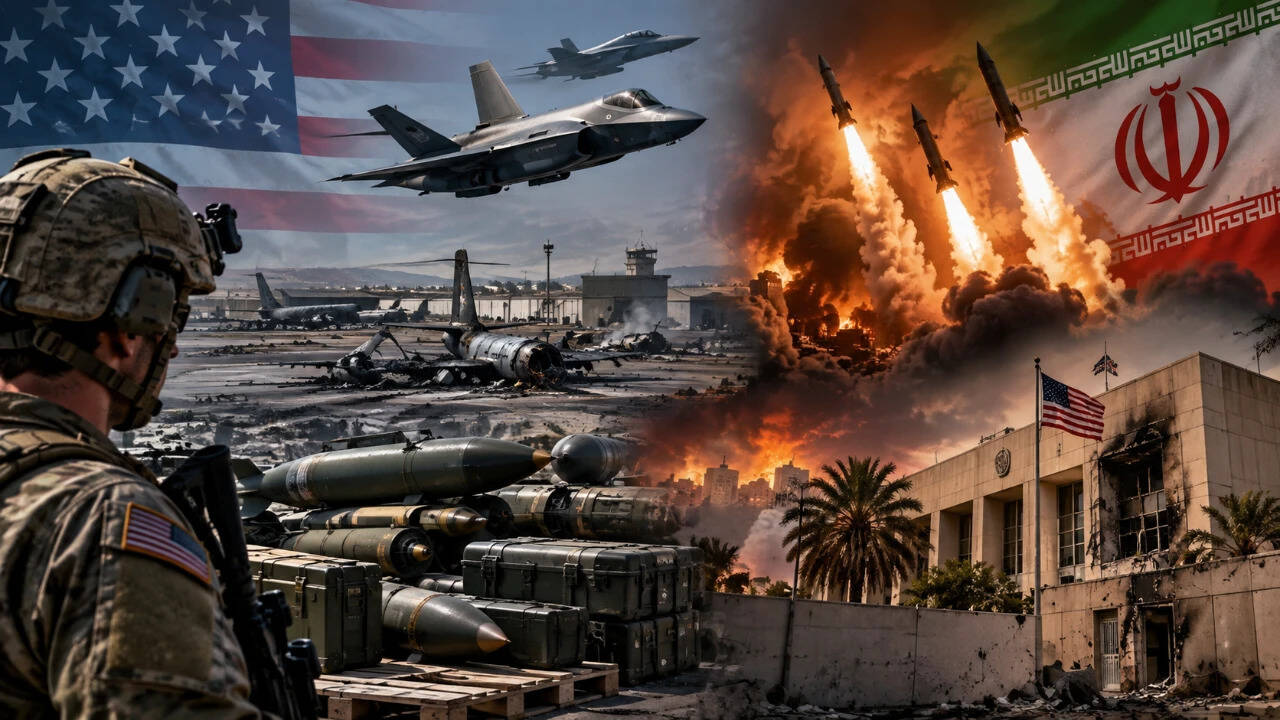
Pentagon watchdog reveals the scale of US losses in the Iran war, from aircraft and drones to military bases and diplomatic facilities. (Representative AI image) The United States has suffered extensive losses to aircraft, military facilities and diplomatic infrastructure during its war with Iran, while a Pentagon watchdog has warned that the conflict has also exposed shortages in advanced munitions and bottlenecks in the US defence supply chain.
A US Department of Defense inspector general report released Monday provided the first official accounting of the damage from the conflict, covering the period from February 28 to June 30. The report said Iranian strikes damaged or destroyed hundreds of buildings and structures at US military installations across eight countries, while dozens of American aircraft and drones were damaged or destroyed.
The report also found that the war had “resulted in strategic inventory shortfalls and revealed industrial base bottlenecks for munitions resupply”, raising questions over Washington's ability to sustain a prolonged high-intensity conflict. The findings come even as President Donald Trump has pushed back against reports of dwindling US weapons stocks.
“I’ve just received a report that the United States is producing more exquisite and elite weapons than at any time in our history. They are being delivered on a daily basis to our Forces in the Middle East and beyond,” Trump wrote.
How much has Iran war cost US? The Pentagon watchdog estimated that about $22 billion was spent on munitions between February 28 and June 30 during Operation Epic Fury, the US military's name for the campaign.
The broader cost of the war was estimated at about $33 billion during the same period, according to the report. 5 billion.
US aircraft losses in the Iran war, including fighter jets, refuelling tankers, helicopters and drones. The report's assessment provides a broader picture of the financial and operational burden on the US military after months of strikes involving American and Israeli forces on one side and Iran on the other.
“Our defense company factories are moving 24/7 while at the same time, building, on average 4-to-5 large-scale brand-new plants, each. A primary focus of this production has been Patriots, THAAD systems, Tomahawks and other standard missile systems, of which we already have large numbers in stock,” Trump wrote.
However, the Pentagon inspector general's report acknowledged shortages in advanced munitions and problems in replenishing stocks. A separate analysis by the Center for Strategic and International Studies found that US stocks of some critical missile interceptors had fallen sharply during the conflict.