
Explained: How BSE traded fewer contracts after CAS but premiums rose 75% in first week
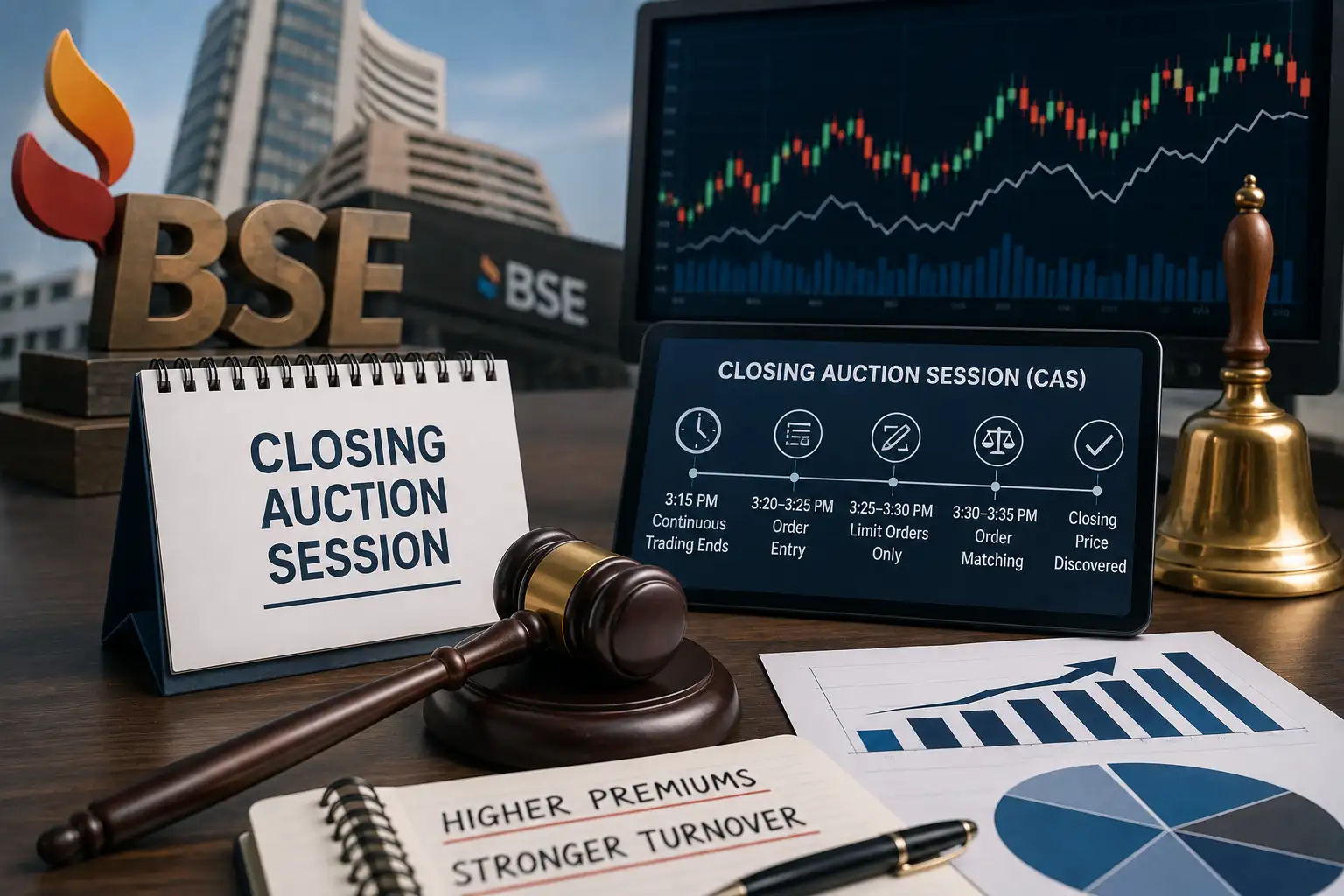
Asia's oldest exchange, BSE, traded far fewer derivatives contracts in the first week following the implementation of the Closing Auction Session (CAS). However, the contracts generated significantly higher premiums, helping the exchange sharply improve its premium turnover and gain market share, according to Nuvama Institutional Equities.Nuvama said the first week of CAS implementation appears to have curbed last-minute swings, fuelling flows into deep out-of-the-money options. This resulted in a sharp decline in the average number of contracts traded, even as premiums rebounded.BSE’s average daily contracts traded fell 30.6% week-on-week to 90 million, compared with a 20.4% decline for the industry. The figure stood at 150 million in July 2026 and 156 million in the first quarter of FY27.Also read: CAS chaos splits Sensex and Nifty: How long will this last?Despite the drop in contracts, the premium generated per contract surged 74.8% week-on-week to Rs 2,605. This compares with Rs 1,688 in July 2026 and Rs 1,902 in Q1 FY27.The increase in premium per contract helped BSE’s average daily premium turnover value rise 21.3% week-on-week to Rs 23,500 crore, significantly ahead of the 9.5% growth recorded by the industry. The figure was also above Nuvama’s remaining FY27E ADPTV estimate of Rs 21,800 crore. As a result, BSE’s ADPTV market share rose to 37.1%, an increase of 362 basis points week-on-week.For FY27 so far, BSE’s average daily premium turnover value stands at around Rs 28,200 crore, while its ADPTV market share is around 35.2%. Its premium-to-notional turnover value ratio stands at around 12.6 basis points, compared with 17.6 basis points for the industry.What is CAS?Market regulator Securities and Exchange Board of India (SEBI) and the National Stock Exchange (NSE) introduced the Closing Auction Session (CAS) for eligible Futures & Options (F&O) stocks which started on August 3. The new framework changes how closing prices are determined for these stocks and extends equity derivatives trading by 10 minutes.For investors, the biggest change is this: the closing price of eligible F&O stocks will no longer be calculated using trades executed during the final 30 minutes of the trading session. Instead, it will be discovered through a dedicated auction held after continuous trading ends.Simply put, CAS is a 20-minute auction that begins after continuous trading ends. Instead of executing every trade instantly as it happens during the trading day, all buy and sell orders are pooled together and matched at one common price. That single price becomes the stock's official closing price.Timing chronology starting 3:15 p.m.The process begins before the auction starts. Between 3 p.m. and 3:15 p.m., exchanges will calculate the volume weighted average price (VWAP) of trades in every eligible stock. At 3:15 p.m., continuous trading in eligible stocks ends, and the market shifts into CAS.For the next five minutes, until 3:20 p.m., no fresh orders can be placed as the market transitions into the auction. From 3:20 p.m. to 3:25 p.m., investors can place both market and limit orders.Read more: CAS sparks trader backlash as losses mount, Sebi holds firmFrom 3:20 p.m. to 3:25 p.m., investors can place both market and limit orders. Between 3:25 p.m. and 3:30 p.m., only limit orders can be entered. Market orders placed earlier cannot be modified or cancelled during this phase. To prevent a flurry of last-second orders, the order entry window will not close at a fixed time. Instead, it will shut randomly between 3:28 p.m. and 3:30 p.m.Once the order entry window closes, exchanges will stop accepting orders and begin matching buy and sell orders between 3:30 p.m. and 3:35 p.m. All successful trades will be executed at a single equilibrium price, which will become the stock's official closing price.The objective is to make the closing price more representative of overall market demand and supply. By bringing together all buy and sell orders at the close, the auction is designed to improve liquidity, help execute large orders more efficiently and arrive at a more robust closing price.The framework is also intended to make it harder for large trades placed in the final minutes of the session to disproportionately influence stock and index closing levels.(Disclaimer: Recommendations, suggestions, views and opinions given by the experts are their own. These do not represent the views of The Economic Times)